Memory, and how much it holds
Memory
Every interface asks the person to hold on to something. The code that came by SMS, the step they were on, where the button they used last week was.
Each of those requests is a withdrawal from a small account. working memoryThe mental space where the person holds what they are using right now. It holds about four things, and they fade in seconds if they are not used.See it in Memory →See in the glossary → holds about four items, and it was already busy before the person opened your product, with the three o’clock meeting, with the bill due today, with what’s left to buy on the way home.
That’s why “simple” almost never means “on a single screen”. A three-step flow can be lighter than a one-step one, if the one-step one requires them to hold in their head what they read at the top. What weighs is how much the person has to hold at each step.
And what is already stored in there isn’t your choice. The person arrives with a repertoire of other screens, and it’s against that repertoire that yours will be read.
How a memory forms
Where a memory passes through, from attention to the trace that stays.
Everything that comes in passes first through that small account, and its balance doesn’t stay. For something to stay, it has to be transferred to another account, and the one who authorises the transfer is the hippocampusThe structure that turns recent experience into lasting memory. Everything your interface asks the person to remember tomorrow passes through it today.See it in Memory →See in the glossary →, a curved structure in the temporal lobe that got its name because it looks like a seahorse. It doesn’t store the memory. It decides what deserves to be stored and distributes it across the cortex, little by little, over hours and nights of sleep, in a process called consolidation. That’s why the person remembers where the button they used last week was and doesn’t remember the code that came by SMS ten minutes ago. One was transferred. The other never left working memoryThe mental space where the person holds what they are using right now. It holds about four things, and they fade in seconds if they are not used.See it in Memory →See in the glossary →.
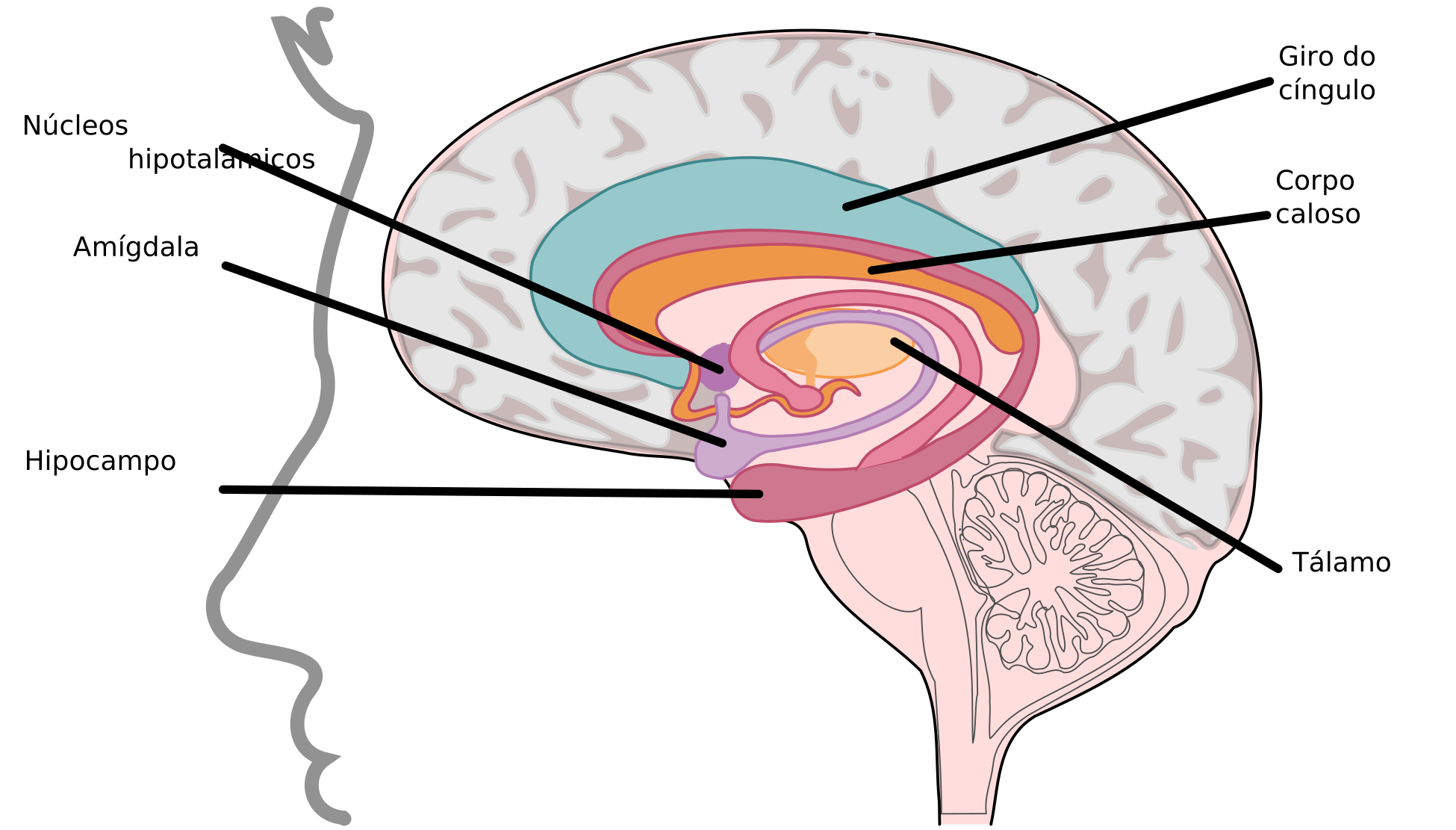
OpenStax College; vectorised by Marnanel · Anatomy & Physiology · CC BY 3.0 · labels translated into Portuguese
How far this holds
The structures and the numbers are well established, but they were measured outside an interface. The jump from here to the screen is mine.
The consolidation route was mapped in patients with hippocampusThe structure that turns recent experience into lasting memory. Everything your interface asks the person to remember tomorrow passes through it today.See it in Memory →See in the glossary → lesions and in rodents with cellular recording. Neither was using an app.
Related neuromyths
-
Each person has a learning style — visual, auditory, kinaesthetic — and learns best in their own.
It’s the most expensive neuromyth in the corporate world, and what it lacks isn’t subtle: it lacks the test. For the claim to hold, you would need to show that those who call themselves visual learn more from visual material than from auditory, and that with the auditory ones the reverse happens. The studies that set up that crossover didn’t find the effect. The preference exists. People prefer a format, and preferring isn’t learning better. What changes performance is the format fitting the material. Maps are taught with images, accents are taught with sound, and that holds for everyone.
-
We only use 10% of our brain.
There’s no idle reserve waiting to be unlocked: brain imaging shows activity everywhere, and a lesion in any region takes something away. What exists is a limit of another kind, and it’s in the vision section. Firing a neuron is expensive, and the cortex’s budget only pays for a tiny fraction of them being substantially active at the same time. There’s no spare capacity kept in store; there isn’t enough energy to use everything at once.
Sensory memory
A quarter of a second of image, about three of sound, before any awareness.
Before any information reaches consciousness, it passes through an ultra-fast buffer, and in vision it’s called iconic memoryThe trace an image leaves for about 250 milliseconds after it leaves the screen. It is what allows comparing two things in the blink of an eye, and what is lost when an element disappears too fast.See it in Memory →See in the glossary →: an image stays alive for about 250 milliseconds, in the measurement George SperlingMeasured visual sensory memory and showed that it keeps almost everything for less than a second.One reference in this work:1960The information available in brief visual presentationsSee on Wikipedia ↗See in the bibliography → made in 1960 by projecting a grid of letters for an instant and asking the person to report a randomly chosen row after the screen went blank. It’s a quarter of a second, and it’s what allows you to compare two things on the screen without looking twice, because the second look still reaches the trace of the first. In sound the window is much wider, something like three seconds, and that’s why you can ask “sorry?” and understand the sentence before it’s repeated. This brief retention costs a lot of energy, and evolutionarily it wouldn’t make sense to prolong it, because we would keep irrelevant details getting in the way of immediate action.
How far this holds
What this part claims was measured this way, and the studies are in the bibliography.
George SperlingMeasured visual sensory memory and showed that it keeps almost everything for less than a second.One reference in this work:1960The information available in brief visual presentationsSee on Wikipedia ↗See in the bibliography → (1960) measured by projecting a grid of letters for 50 milliseconds and asking, once it was gone, that the person report a randomly chosen row. Full report failed; partial report didn’t. That’s how it became known that the whole image had been there.
Working memory
About four items fit, and your form competes with the rest of life.
The small account every interface draws on has a technical name, working memoryThe mental space where the person holds what they are using right now. It holds about four things, and they fade in seconds if they are not used.See it in Memory →See in the glossary →, and it has an address. It depends on frontoparietal circuitsThe pair that supports working memory: the prefrontal cortex holds the information active while the parietal lobe keeps track of where things are.See it in Memory →See in the glossary →, in which regions of the prefrontal cortexThe region behind the forehead, where the person decides, plans and sustains attention. It keeps one thing in focus at a time and inhibits the rest: it is where the bottleneck of conscious decision usually tightens.See it in Memory →See in the glossary → keep the neuronal patterns active while the parietal lobe integrates the spatial and sensory context. On average, we hold about four elements at the same time, in the number CowanRedid Miller’s count with a better method and arrived at about four items, not seven. It is the number this site uses.One reference in this work:2001The magical number 4 in short-term memorySee in the bibliography → established in 2001 after reviewing the span tasks with verbal rehearsal blocked. There’s no point showing five complex menus at once, because working memory simply doesn’t accommodate them. And even within those few seconds, the representations are subject to synaptic noise, and distractions and competing details can erase them before use.
How far this holds
What this part claims was measured this way, and the studies are in the bibliography.
The four items come from span tasks with digits, letters and positions on a grid, with verbal rehearsal blocked to prevent chunking tricks. Chair, headphones and a black screen. No form.
The four items aren’t four form fields. What fits is four meaningful chunks, and the size of a chunk depends on what the person already knows: for someone who knows the subject, a whole sentence is one item; for someone who doesn’t, each word is. That’s why the same screen fits comfortably in an experienced user and overflows in a novice. And the number drops even further when the head is already occupied with hurry, fear or a bill to pay. It’s what I recount in the chapter on the condition of the body, with the farmers who took the same tests before and after the harvest and did better after.
Spatial memory
Why moving a button costs more than it seems.
Part of that memory is about where things are, and it’s the oldest of all. Linked to the hippocampusThe structure that turns recent experience into lasting memory. Everything your interface asks the person to remember tomorrow passes through it today.See it in Memory →See in the glossary →, spatial memory allows us to navigate physical and digital environments: place cells in the hippocampus and grid cells in the place and grid cellsThe internal GPS, in the hippocampus and its surroundings. It evolved to remember paths to water and food, and it is the same one that remembers where that button was on the previous screen.See it in Memory →See in the glossary → create an internal map of space, used both to remember where we clicked in an interface and to go back to the previous page. Keeping navigation patterns consistent, with the menu in the same place on every screen, exploits that ancient resource. And “ancient” here is stronger than it seems. Memory and navigation run on the same neuronal algorithms, and the hypothesis BuzsákiDescribed how the theta rhythm of the hippocampus sustains memory and navigation, the same machine for remembering and for finding one’s way in space.One reference in this work:2013Memory, navigation and theta rhythm in the hippocampal-entorhinal systemSee in the bibliography → and Moser defended in 2013 is that the mechanisms for remembering evolved from the mechanisms for finding one’s way in physical space. The brain didn’t gain a new part to deal with menus and the way back; it reuses the one that served to find the way to water.
How far this holds
The structures and the numbers are well established, but they were measured outside an interface. The jump from here to the screen is mine.
Place and place and grid cellsThe internal GPS, in the hippocampus and its surroundings. It evolved to remember paths to water and food, and it is the same one that remembers where that button was on the previous screen.See it in Memory →See in the glossary → were recorded in rodents crossing boxes, and confirmed in humans during navigation in virtual environments. What was measured was people walking down corridors with walls, not people using an interface.
Spatial memory presupposes that there is space. Someone who navigates by keyboard or by screen reader has no “top right corner”: they have focus order and heading structure, and the map that person builds is sequential. Moving a button is costly for them too, only the cost shows up in the order, not in the position. If your argument for not touching the screen is spatial, it covers part of the audience, and for the rest you need the reading-order argument.
Medium- and long-term memory
70% of what the person learned today is gone in 24 hours.
When a piece of information is repeated or deemed relevant, the trace leaves the hippocampusThe structure that turns recent experience into lasting memory. Everything your interface asks the person to remember tomorrow passes through it today.See it in Memory →See in the glossary → and settles in areas of the cortex, and from then on memory divides by type of content. Episodic and semantic memory spread across the neocortex and, over time, stop depending on the hippocampus and the medial temporal cortexThe inner part of the temporal lobe, hippocampus and surroundings, through which fact and episode pass to become lasting memory. Its role is temporary: over time the memory ends up stored in the cortex and stops depending on this region.See it in Memory →See in the glossary →; procedural memory, tied to motor skills such as typing and gesturing on screens, consolidates in the basal gangliaTogether with the cerebellum, they store what the body learned to do without thinking: typing, swiping, reaching an icon. It is the memory that survives distraction.See it in Memory →See in the glossary → and the cerebellumThe structure low at the back of the skull that automates movement and sequence. The more someone uses your product, the more the operation migrates here, and the costlier it gets to change what has already become automatic.See it in Memory →See in the glossary →; prospective memory, remembering to do something in the future, involves planning networks in the prefrontal cortexThe region behind the forehead, where the person decides, plans and sustains attention. It keeps one thing in focus at a time and inhibits the rest: it is where the bottleneck of conscious decision usually tightens.See it in Memory →See in the glossary →.
How much of that survives has a number, and it’s an old one. The forgetting curve EbbinghausMeasured his own memory for years, with nonsense syllables, and drew the forgetting curve and the serial position effect.One reference in this work:1885Über das GedächtnisSee in the bibliography → measured in 1885, memorising nonsense syllables, still holds: without reinforcement, whether review, repetition or emotional context, we lose up to 70% of new content within 24 hours, and MurreReplicated Ebbinghaus’s forgetting curve more than a century later, and it held.One reference in this work:2015Replication and analysis of Ebbinghaus’ forgetting curveSee in the bibliography → and Dros replicated the curve in 2015 with the same result. Without repetition and without emotional charge, the trace weakens before consolidation is finished, and it’s the same mechanism that appears in the chapter on emotion.
How far this holds
What this part claims was measured this way, and the studies are in the bibliography.
EbbinghausMeasured his own memory for years, with nonsense syllables, and drew the forgetting curve and the serial position effect.One reference in this work:1885Über das GedächtnisSee in the bibliography → (1885) measured on himself, alone, memorising nonsense syllables and recounting what was left after growing intervals. The curve was replicated more than a century later, and it’s still meaningless material: it’s the worst case, not the average case.
The 70% in 24 hours comes from the Ebbinghaus curve, which was replicated more than a century later and held up, which is rare and counts very much in its favour. Except that meaningless material is the worst possible case. What your interface asks people to remember almost always has meaning, context and repetition, and fades more slowly. Use the number as a ceiling for forgetting, not as a forecast.
The other parts of the engine