The social, and where it distorts
The social mind
When your product shows what other people did — the rating, the user count, the “who liked this” — it is operating a circuit hundreds of thousands of years older than the internet.
That circuit was calibrated for groups of about 150 people: the size at which you can know who’s who, who owes what to whom, and who is worth copying. It’s still that size. What changed was the number of people it is forced to process.
Hence the weight of the social number on your screen. It isn’t a conversion ornament: it’s the strongest signal you have available, and therefore the most expensive to fake. A made-up number brings down trust in everything else that is there.
Dunbar’s number
About 150 people, says the most cited estimate. The scale hasn’t changed; the networks just started ignoring it.
Since the first hunter-gatherer bands, our survival has been tied to the ability to cooperate in relatively small groups, and the most cited estimate for the size of those groups is Robin DunbarRelated the size of the cortex to the size of the stable social group, and from there came the number repeated as one hundred and fifty.One reference in this work:1998The social brain hypothesisSee on Wikipedia ↗See in the bibliography →’s, from 1998: stable social relationships with something around 150 people. To sustain those connections, the brain recruits circuits of its own. The mentalising networkThe circuit that infers what goes on in other people’s heads: intentions, beliefs, desires. It is what comes into play when the interface has people on the other side, in the rating, in the comment, in the count of those who have already bought.See it in The social mind →See in the glossary →, temporoparietal and in the medial prefrontal cortexThe part of the prefrontal cortex that thinks about people: what others want, what they think of us, whether they can be trusted.See it in The social mind →See in the glossary →, is the one that infers what the other person wants and thinks, in the map FrithDescribed the neural base of mentalising, the machine for inferring the other’s intention, which the Illusion of transparency shows failing.One reference in this work:2006The neural basis of mentalizingSee in the bibliography → and Frith consolidated in 2006. A mention of mirror neuronsCells that fire both when you do something and when you see someone else doing it. They were proposed as the basis of imitation and empathy, a reading the field itself has already corrected, and what is left is that seeing someone act partly activates the system of the one who acts.See it in The social mind →See in the glossary →, in the frontal and parietal cortices, usually comes along with it, and here it’s worth holding back. The phenomenon is solid, and seeing someone act partially activates the system of the one acting, as RizzolattiDescribed the system of mirror neurons, and his is the base — much cited and much exaggerated — of intention reading.One reference in this work:2004The mirror-neuron systemSee in the bibliography → and Craighero reviewed in 2004. But the popular reading, that they would explain empathy and intention reading, went far beyond what the data support, and the field went through a strong correction. What remains applicable is the partial activation of the system of the one who acts.
At bottom, it’s energy economy. Consciously tracking every detail of everyone’s behaviour would be far too expensive, so the brain resorts to shortcuts that select the essentials: who tends to cooperate, who poses a risk, who offers support.
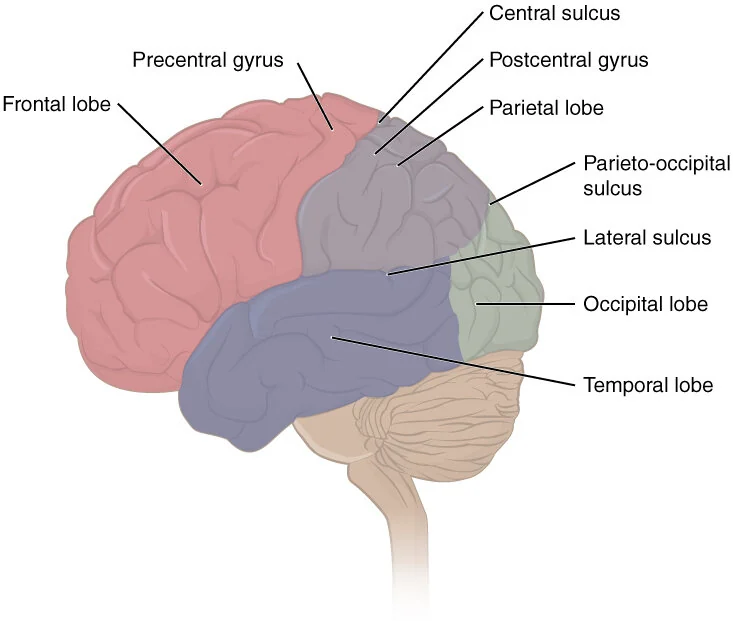
frontal (planning and decision) · parietal (space and attention) · temporal (hearing, language and memory) · occipital (vision)
OpenStax · Anatomy and Physiology (2016) · CC BY 4.0
How far this holds
The structures and the numbers are well established, but they were measured outside an interface. The jump from here to the screen is mine.
Robin DunbarRelated the size of the cortex to the size of the stable social group, and from there came the number repeated as one hundred and fifty.One reference in this work:1998The social brain hypothesisSee on Wikipedia ↗See in the bibliography →’s 150 (1998) wasn’t measured in anyone. The social circuits cited here come from functional imaging with photos of faces and laboratory economic games.
The argument holds for relationships that demand reciprocity: knowing who’s who, who owes what to whom. A good part of what a social network counts as a connection isn’t that. Following someone creates no obligation at all, and fitting within a follower count says nothing about fitting within a social circuit. Before using this chapter to justify a list limit, ask which of the two types the relationship your product creates belongs to.
Related neuromyths
-
The human brain holds exactly 150 relationships. It’s Dunbar’s number.
The 150 wasn’t counted in anyone: it’s the extrapolation of a line relating neocortex size and group size in primates, extended to the point where the human would sit. LindenforsRedid the extrapolation that produces Dunbar’s number and found confidence intervals so wide that the limit does not hold up.One reference in this work:2021“Dunbar’s number” deconstructedSee in the bibliography →, Wartel and LindReviewed the choice-supportive bias and separated four forms of it, only one has solid support, which narrows the law considerably.One reference in this work:2017Choice-supportive misremembering: a new taxonomy and reviewSee in the bibliography → (2021) redid the calculation and arrived at means of 69 to 109 people by the Bayesian method and 16 to 42 by phylogenetic least squares, with confidence intervals of 4 to 520 and 2 to 336. Their conclusion is that a cognitive limit on group size can’t be derived by that route. What survives, and it’s what this chapter uses, is the shape of the argument: the social circuit was calibrated for small groups and now processes thousands. No design decision here depends on the number being 150.
Empathy and alterity
Two empathies, one fast and one slow. The interface only reaches the slow one.
Empathy is feeling or imagining yourself as the other. Alterity is recognising yourself as different from them. Both are necessary, and it’s the second that almost never shows up in a design process.
Emotional empathy is visceral and immediate: we feel what the other feels. It’s great between two people and bad as a design compass, because it doesn’t distribute evenly. Paul BloomAssembled the case against empathy as a moral guide: feeling with the other pulls towards those who look like us and vanishes for those who are many or distant.One reference in this work:2016Against empathy: the case for rational compassionSee in the bibliography → gathered the argument in Against Empathy (2016): we feel more for those who look like us, speak our language and are right in front of us. And we feel less, not more, when the number grows. One child with a name and a face moves us more than ten thousand without names, and that is how the mechanism works.
In a project room this has a consequence and no name: the user the team can imagine gets the flow, and the one it can’t imagine disappears from the scope without anyone having decided that. Nobody voted against them.
That’s why personas exist, and that’s why one alone isn’t enough. The persona is the attempt to give a face to those the team can’t imagine on its own, and it works to the extent that it comes from research and not from assumption: made from inside the room, it reproduces the same bias with the look of a method. The cure is the same as for empathy, fewer people like you in the sample. It’s what the extreme-user interview does on purpose.
Cognitive empathy is deliberate: we put ourselves in the other’s place on purpose, imagining motivations, constraints and goals. It runs on the mentalising networkThe circuit that infers what goes on in other people’s heads: intentions, beliefs, desires. It is what comes into play when the interface has people on the other side, in the rating, in the comment, in the count of those who have already bought.See it in The social mind →See in the glossary →, which joins the medial prefrontal cortexThe part of the prefrontal cortex that thinks about people: what others want, what they think of us, whether they can be trusted.See it in The social mind →See in the glossary → to the temporoparietal, and it’s slower precisely because it’s constructed. It’s what allows you to understand someone with a repertoire different from yours without depending on being moved, and that’s why, in design, it yields more: it gives distance and makes room for data.
But both are still me projecting myself onto you. Alterity starts somewhere else. Empathy starts from identification; alterity starts from the opposite: the other isn’t a reflection of me, and their experience can’t be simulated whole. It can be asked about. When a designer says “I put myself in the user’s shoes”, they have described a method of one person, with a sample of one person, and that person is them.
Which body were you talking about when you put yourself in their place? It’s the question that The body, the section of this site that investigates this, asks of the catalogue, and that here you ask of your own process. I call it a catalogue, and not laws, because a law is what we stop questioning.
And the social brain doesn’t choose between the two: it uses the fast one all the time and the slow one when there’s something left over. This gap, between the small group the circuit was calibrated for and today’s scale, has a name in the literature, and it’s the evolutionary mismatch hypothesis. A mechanism that solved the environment it was shaped in well starts returning bad answers when the environment changes faster than it does, in the formulation of LiOrganised the evolutionary mismatch hypothesis: a mechanism shaped in one environment returns a bad response when the environment changes faster than it does.One reference in this work:2018The evolutionary mismatch hypothesis: implications for psychological scienceSee in the bibliography →, van Vugt and Colarelli, from 2018. Emotional empathy is a clean case of this. It was calibrated for whoever is nearby, because for tens of thousands of years whoever was nearby was practically everyone the person would ever know in their life. Today the same mechanism is presented to millions a day and responds by choosing one.
This hypothesis organises what is observed well, and it hasn’t been measured the way an experiment measures. You can’t run the Pleistocene again with a control group, and so it serves as a lens, not as proof. Cognitive empathy is the one that reaches those who aren’t nearby, and it costs attention, time and willingness, which is exactly what’s missing on a delivery Tuesday. Alterity isn’t a third empathy. It’s what keeps the cognitive kind from turning into the emotional kind in disguise, by remembering that simulation has a limit and that behind the limit there is someone to ask.
How far this holds
My own reasoning from the mechanism. I found no study that had measured this in this form.
The separation between emotional and cognitive empathy is well established in the literature, and the argument against using the emotional kind as a compass is BloomAssembled the case against empathy as a moral guide: feeling with the other pulls towards those who look like us and vanishes for those who are many or distant.One reference in this work:2016Against empathy: the case for rational compassionSee in the bibliography →’s (2016). What I draw from it for design is mine. I found no study that had measured what happens to a product’s scope when the team uses one or the other.
Related neuromyths
-
Mirror neurons create empathy and read the intention of whoever is using it.
Start with what is true, because it’s a lot. Seeing someone act partially activates the system of the one acting, and that is solid. When you watch a video of someone stubbing their little toe and flinch in your chair, something really is happening: SingerMeasured people watching a loved one receive a shock and separated what hurts from how much it bothers: only the second part lights up in the one watching.One reference in this work:2004Empathy for pain involves the affective but not sensory components of painSee in the bibliography → and colleagues (2004) measured people watching a loved one receive a shock, and the areas that register how much the pain bothers lit up the same as in the person receiving the shock. The ones that register where it hurts did not. You feel the unpleasantness, not the blow, and that’s why you can watch without walking away limping.
O que foi longe demais é a conclusão. A leitura popular fez dos espelhos a base da empatia, da linguagem e da cultura, e a área passou por uma correção forte. Ativação compartilhada não é a mesma coisa que entender a intenção do outro, e nada disso explica por que a empatia é enviesada do jeito que é. Sobra o modesto, e o modesto é útil. Para quem projeta a diferença é prática: dá para dizer que a pessoa reagiu ao que viu; não dá para dizer que ela entendeu o que o outro queria.
Isto é a mesma forma de erro que Onde a evidência não alcança descreve: uma estrutura real, um achado real, e uma ponte que ficou grande demais para o pilar. E eu não estou de fora dela. Gravei em 2020 uma conversa sobre empatia e alteridade que continua valendo no argumento e tem imprecisões na parte do mecanismo, do tipo que esta seção corrige. Deixo o link porque tirar seria mais fácil e menos honesto: é o mesmo movimento que este site pede de quem cita uma lei sem olhar a amostra.
Social networks and false proximity
False proximity: social software running outside the scale it was made for.
Digital networks exploit this inherited social software. By letting us follow thousands of profiles, they create an illusion of proximity: we believe we know people with whom we’ve never exchanged more than a “like”. The scale of the social circuit hasn’t changed, and the brain keeps processing this information as if we belonged to small groups.
Two effects follow from this. The first is false proximity, because seeing strangers’ stories side by side with those of close friends, we grant both the same trust. The second is high-speed social signalling, since what once circulated by word of mouth, at a pace that could be checked, now reaches global scale in seconds, with no human filter.
A product that encourages social interaction needs to take this into account, and what I propose is modest: highlight close ties instead of displaying every follower, signal when a comment comes from the real circle, and avoid notifications about people with no bond. It’s recreating, digitally, what happened in small groups, without overloading the natural system of social filtering.
How far this holds
My own reasoning from the mechanism. I found no study that had measured this in this form.
There’s no study behind this: it’s my reading of what happens when a circuit calibrated for dozens of people starts processing thousands. I looked for a measurement and didn’t find one.
The other parts of the engine