Users spend most of their time on other sites. This means that users prefer your site to work the same way as all the other sites they already know.
Break the pattern only when you can say why.
People spend almost all of their time on other products, not on yours. That is why they arrive expecting the basket to be in the top right-hand corner and the logo to take them home: that repertoire was built somewhere else, and you inherit it ready-made. Jakob NielsenWrote the ten usability heuristics and created the heuristic evaluation method that this site treats as triage, not as a test.4 references in this work:199410 usability heuristics for user interface design2000End of Web Design2009Short-term memory and web usability1990Heuristic evaluation of user interfacesSee in the bibliography → formulated this in 2000, when the pattern came from websites. Today it also comes from social networks, and not only from position. Gestures like pull to refresh or swipe sideways have become as firm a convention as any icon. Breaking a pattern like that is possible, but it needs to be a decision, not carelessness.
The biological mechanism behind the effect, and how much of it was actually measured.
What the law describes is expectation formed by exposure: the person found the basket in the top right-hand corner hundreds of times and came to look for it there before reading any label. Cognitive psychology calls this a schema, and the effect is well documented. Material that confirms the schema is recognised faster and with fewer errors; material that contradicts it costs a correction, and that correction is the friction the law says to avoid. A schema is long-term memoryWhat the person still knows tomorrow of what they saw today. It does not live in one place only: it forms through the hippocampus and, over time, comes to live spread across the cortex.See it in Memory →See in the glossary →, and the literature ties its formation to the hippocampusThe structure that turns recent experience into lasting memory. Everything your interface asks the person to remember tomorrow passes through it today.See it in Memory →See in the glossary → and the already consolidated schema to the ventromedial prefrontal cortexIt makes the global judgement, the final opinion on an entire experience, not on each moment of it. It is because of it that the person sums up a ten-screen flow in a single sentence.See it in Emotion →See in the glossary →, as GilboaOne reference in this work:2017Neurobiology of schemas and schema-mediated memorySee in the bibliography → and Marlatte reviewed in 2017. What was measured there were schemas assembled in the laboratory, and not the repertoire of someone who uses ten sites a day, and the link to the law is mine. Where it is measured is still response time and error.
The body this law presumes
Who it was measured on, and what changes when the body on the other side is another.
“The other sites” is a population, not a constant. Someone who has just arrived on the internet, someone who comes from WeChat, someone who reads from right to left has a different “other sites”, and the convention you follow may not be theirs.
How design translates it
What to do with it on a screen, without turning a finding into a rule.
Breaking the pattern without need charges a correction from whoever arrived expecting something else, and the frustration appears before the functional evaluation. Respecting Jakob’s law is not giving up on innovation, but balancing innovation and familiarity, accommodating the mental maps already recorded.
Where it breaks
Where the law does not hold, holds less, or holds in reverse.
Taken to the extreme, it freezes the whole category: if nobody breaks the pattern, the bad pattern survives by consensus.
Um caso
A real product where this showed up, with what happened and where to check it.
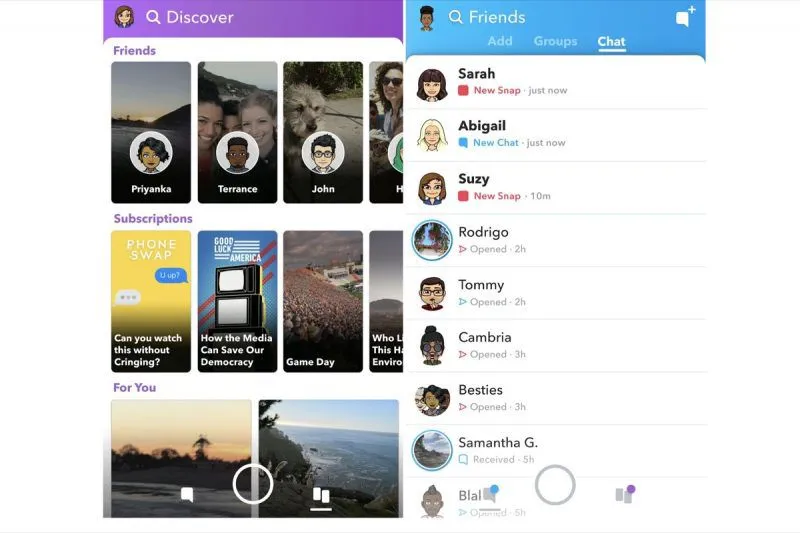
At the beginning of 2018 Snapchat launched a redesign that separated friends from creators and put friends’ Stories together with Chat, on the left-hand side of the camera. A petition asking for the previous version passed 1.2 million signatures, and the company replied that it would not go back. On the first-quarter earnings call, on 1 May, Evan Spiegel admitted ↗ that putting watching Stories and chatting with friends in the same place made it harder to optimise both behaviours, and announced that friends’ Stories would go back to the right. In August, on the second-quarter earnings call, Snap reported the first drop in daily users in its history, from 191 to 188 million, and attributed the drop to the disruption caused by the redesign. The company also reported gains, such as higher retention among new users over 35, and partly blamed performance problems on Android. The law is usually read as “look like the other sites”. Here the broken convention was the product’s own, the habit that millions of people had built inside it. Whoever redesigns a product used every day is tampering with a mental map, and the bill comes due in frequency of use.
A piece to check in your own body what the text has just claimed.
Where the like is
A post, and beneath it four actions with no label and no icon. Click the one you would use to like it — without searching, the way you would while scrolling the feed.
Click one of the four actions.
There was no icon or label to read: what guided the finger was a map built in every other feed you have ever scrolled through. That map is what Jakob’s law describes, and it forms where time is spent, which makes the most used interfaces, not the best designed ones, the reference for where things are. Breaking the pattern is not forbidden; it is a debt someone will pay, and the least you can do is know it was taken on deliberately.