regra
Peak–end rule
The evaluation of an experience does not depend on the average of all its moments, but on the intensity of its most striking point and of its ending.
Invest in the high point and the ending; the middle is hardly remembered.
The memory of an experience is not the average of what happened, but almost entirely made of the most intense moment and the ending. Daniel Daniel KahnemanHalf the work this catalogue cites passes through him: anchoring, availability, the endowment effect, peak–end, the two systems.5 references in this work:2011Thinking, fast and slow1966Pupil diameter and load on memory1993When more pain is preferred to less: adding a better end1990Experimental tests of the endowment effect and the Coase theorem1991Anomalies: the endowment effect, loss aversion, and status quo biasSee on Wikipedia ↗See in the bibliography → and Donald RedelmeierMeasured, with Kahneman, the memory of painful medical procedures and showed that the peak and the end weigh more than the duration.2 references in this work:1996Patients’ memories of painful medical procedures: real-time and retrospective evaluations…2003Memories of colonoscopy: a randomized trialSee in the bibliography → documented this by following patients through medical examinations, and the result is so counterintuitive it is uncomfortable: a longer procedure can be remembered as less bad, as long as the end is milder. It holds for the support call that took a long time but ended well resolved, and it holds for the flow that went smoothly until it froze on the last screen. The end has disproportionate weight, and it is usually the least cared-for part of the project.
What the brain does with it
The biological mechanism behind the effect, and how much of it was actually measured.
The effect is among the best established in the psychology of decision, and it is worth distinguishing the three studies that support it, because they do different things. In 1993, Kahneman, Fredrickson, Schreiber and Redelmeier had people plunge a hand into water at 14 degrees for 60 seconds and then repeat the same thing with 30 seconds more, during which the water rose to 15, still painful and slightly less so. When it came to choosing which one to repeat, most chose the longer version, and that is where the rule got its name. In 1996, Redelmeier and Kahneman followed 287 patients through procedures that were already scheduled, recording pain minute by minute, and the memory of the whole tracked the worst moment and the final moment, without longer procedures being remembered as worse. It was observation, with nothing manipulated. In 2003, with Katz, came the test. There were 682 randomised patients, half receiving an extension with the scope held still at the end, final pain 1.7 versus 2.5, and a less bad overall rating. None of the three measured the brain. Episodic memory and retrospective judgement are the ground where the effect lives, and forming and retrieving an episode depends on the hippocampusThe structure that turns recent experience into lasting memory. Everything your interface asks the person to remember tomorrow passes through it today.See it in Memory →See in the glossary → and the medial temporal cortexThe inner part of the temporal lobe, hippocampus and surroundings, through which fact and episode pass to become lasting memory. Its role is temporary: over time the memory ends up stored in the cortex and stops depending on this region.See it in Memory →See in the glossary →, as SquireOne reference in this work:1991The medial temporal lobe memory systemSee in the bibliography → and Zola-Morgan reviewed in 1991. The link between those structures and the peak–end rule is mine.
The body this law presumes
Who it was measured on, and what changes when the body on the other side is another.
What remains of an experience is the peak and the end, and the reasonable suspicion was that this would vary in people with impaired episodic memory. The meta-analysis by AlaybekGathered 174 measurements of the peak–end rule in a meta-analysis and found the effect large and stable, stronger even than the duration of the experience.One reference in this work:2022All’s well that ends (and peaks) wellSee in the bibliography → and colleagues gathered 174 measures and did not find that fragility. The effect is large and stayed stable across everything they tested as a possible source of variation, including age, type of experience and way of measuring, and came out stronger than the duration of the experience, which practically does not count. This is one of the few laws that came out firmer after being checked.
How design translates it
What to do with it on a screen, without turning a finding into a rule.
How to measure this in your product
Invest in the high point and the ending. The purchase flow that went smoothly and froze on the confirmation screen is remembered for the freeze; the support call that took a long time and ended with the problem solved is remembered for the resolution. In the most-cited figure of the 1996 study, two patients appear. One spent about eight minutes and ended at the peak, the other spent about twenty-four with the pain falling until the end, and it was the second who kept the less bad memory. It is a pair of cases, not an average, because the comparison between groups only came in 2003, with the examination extended by a few minutes with the scope held still. Long journeys can be remembered well, as long as they have a real high point and end well.
Where it breaks
Where the law does not hold, holds less, or holds in reverse.
Not every peak should be manufactured. Disproportionate celebration of a trivial task creates a peak where there was none, and the person learns to distrust your celebration, even when it is deserved. The rule itself is more modest than its fame, and not where people usually say. The meta-analysis by Alaybek and colleagues, from 2022, found the effect large and stable, and found the duration of the experience with practically no weight. What it found that is uncomfortable was something else, because the simple average of all the moments predicted the final rating as well as the peak-and-end pair did. The middle is where the person spends most of the time, and bad time costs even when it is poorly remembered.
Related neuromyths
What gets said about this concept out there, and what the evidence actually shows.
-
The user decides in the first 50 milliseconds, the first impression settles everything.
The original finding is about a judgement of appearance formed very quickly, not about a decision to use. And this rule says almost the opposite: what remains of the whole experience is the peak and the end, not the opening. If the first impression settled everything, there would be no reason to look after the ending.
Um caso
A real product where this showed up, with what happened and where to check it.
The sweaty hand, the high five and the test that measured
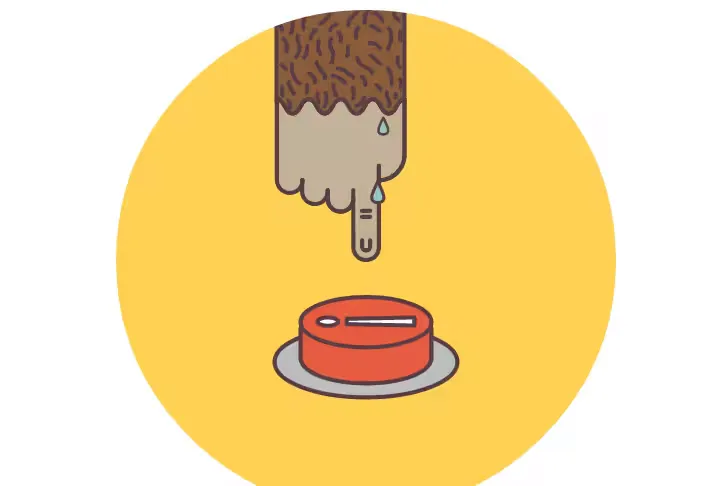
Mailchimp · illustration of Freddie, via The Next Web · Uso editorial
Building an email campaign is long and monotonous, and Mailchimp invested in the two points the rule predicts. On the confirmation screen, the mascot’s hand trembled over a big red button, and after sending he gave a high five. Aarron Walter, the company’s UX director at the time, described the decision as acknowledging the emotional journey of sending a campaign, anxiety before and joy after, and recorded that tens of thousands of customers shared the moment. It is anecdotal evidence, and the animation went away in later redesigns. The measurement came from a 2026 study in a vocabulary app. Sessions with four or eight words received the same rating, and the average of the best page and the last one predicted the final score much better than the average of all the pages. The same study found the limit, because improving the peak and the end together yielded less than the sum of the two. If you can only look after two moments of the flow, look after the peak and the end, without expecting the gains from the two to add up.
Experimente
A piece to check in your own body what the text has just claimed.
The same wait, in two places
Two short rounds. In each one you click the target six times and go through a four-second wait. Do both and say which felt longer.
Start with round A.
Both rounds last the same. In A the wait comes at the end, and that is what the memory is made of; in B it comes at the start and is forgotten during the clicks. In the 1996 study, the patient who went through the longer procedure, but with the milder ending, kept the less bad memory. The end weighs more than the duration.
Neighbouring concepts
Structures linked by a bridge of my own
Sibling concepts
Fontes
Enunciado citado de Redelmeier; Kahneman, 1996; Redelmeier; Katz; Kahneman, 2003.
- REDELMEIER, D. A.; KAHNEMAN, D. Patients’ memories of painful medical procedures: real-time and retrospective evaluations of two minimally invasive procedures. Pain, v. 66, n. 1, p. 3-8, 1996. DOI
- REDELMEIER, D. A.; KATZ, J.; KAHNEMAN, D. Memories of colonoscopy: a randomized trial. Pain, v. 104, n. 1-2, p. 187-194, 2003. DOI
Leitura complementar: Peak-End Rule Laws of UX em inglês