lei
Fitts’s law
The time to reach a target is a logarithmic function of the ratio between the distance to the target and the size of the target.
An important target is a big target, close to where the hand already is.
The smaller the target and the further away it is, the more time it takes to hit it. Paul Paul Morris FittsMeasured, in 1954, the time to point at a target as a function of its distance and size. Young, right-handed, in a laboratory.One reference in this work:1954The information capacity of the human motor system in controlling the amplitude of movementSee on Wikipedia ↗See in the bibliography → measured this in 1954, when there was no mouse and no screen. He was an aviation psychologist and wanted a general measure of how much information a hand can produce per second; what he timed in the laboratory was a stylus tapping between two metal plates, with sixteen right-handed university students. The relationship he found still holds for the finger on the phone, and it is the reason the most important button on the screen needs to be the biggest and the closest to where the hand already is.
What the brain does with it
The biological mechanism behind the effect, and how much of it was actually measured.
Reaching a target on the screen recreates the challenge of aiming at an object in the real world, and what costs time here is not reading the screen, it is producing and correcting the movement. It sets off fast towards the target and then enters a phase of fine corrections, guided by what the eyes see, until it stops inside it. The smaller the target, the more correction cycles, and it is this phase that Fitts’s formula captures. The cerebellumThe structure low at the back of the skull that automates movement and sequence. The more someone uses your product, the more the operation migrates here, and the costlier it gets to change what has already become automatic.See it in Memory →See in the glossary → is one of the structures most associated with this adjustment of the trajectory during the movement itself, measured in motor reaching tasks; the link to the law itself is a bridge, not a finding.
The body this law presumes
Who it was measured on, and what changes when the body on the other side is another.
Fitts measured young right-handed people in a laboratory in 1954. BravoRepeated the measurement of Fitts’s law in adults with cerebral palsy, in 1993. That measurement is where the number the page cites comes from.One reference in this work:1993A study of the application of Fitts’ law to selected cerebral palsied adultsSee in the bibliography → and colleagues repeated the measurement in 1993, with six adults with cerebral palsy and six without. In the group without, the law held. In the group with, it did not hold for most. And there are also those who navigate by keyboard, for whom the law has nothing to measure, because there is no distance to the target, there is a number of tab presses. Add to that the hand holding the rail on the bus and the screen that responds late, and the big, close target stops solving things on its own.
How design translates it
What to do with it on a screen, without turning a finding into a rule.
How to measure this in your product
Enlarging the clickable area and bringing the critical element closer to where the hand already is reduces both terms of the equation at once, less distance to cover and less correction at the end of the movement. Think of the button that confirms a payment on the phone. If it sits at the top of the screen, far from the thumb, and is the height of a line of text, the person misses, hesitates and sometimes hits the wrong button next to it.
Where it breaks
Where the law does not hold, holds less, or holds in reverse.
A target that is too big is also a failure when the action is destructive. “Delete account” should not be the easiest button on the screen to hit.
Um caso
A real product where this showed up, with what happened and where to check it.
The button that missed by a pixel
BetaWiki · via Wikimedia Commons · Domínio público
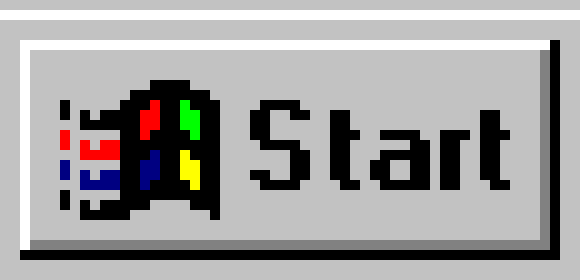
In Windows 95, the Start button sat in the bottom left corner of the screen, and a screen corner is the best target there is, because the cursor cannot go past the edge. The hand can throw the mouse over there without aiming. Except that the button had a dead pixel along its left and bottom edges, and clicking exactly on that pixel opened nothing. Jensen Harris, from the Office interface team, recounted in 2006 that this produced a surprising number of lost clicks, and that the Windows team fixed the pixel before Windows 2000. One pixel turned the easiest target on the screen into a small, distant target, which is the slow case of the formula. A button flush against the edge needs to respond all the way to the edge, otherwise the advantage of the position becomes a trap.
Experimente
A piece to check in your own body what the text has just claimed.
Measure your own click time
Click button A, then B, then A again, alternating between the two. Use the controls to change the target size and the distance between them, and watch what happens to your average time.
- Index of difficulty
- —
- Your average time
- —
- Clicks
- 0
The index of difficulty is log₂(2D/L): doubling the distance costs the same as halving the target. Increase the distance and reduce the width, and your time goes up along with the index, without you having to try any harder.
Neighbouring concepts
Structures linked by a bridge of my own
Sibling concepts
Fontes
Enunciado citado de Fitts, 1954.
- FITTS, P. M. The information capacity of the human motor system in controlling the amplitude of movement. Journal of Experimental Psychology, v. 47, n. 6, p. 381-391, 1954. DOI
Leitura complementar: Fitts’s Law Laws of UX em inglês