Emotion, and why it arrives first
Emotion
The first reaction to a screen isn’t a judgement. It’s a reflex, and it arrives first, through pathways faster than consciousness.
Fast doesn’t mean separate. There isn’t an emotional brain on one side and a rational one on the other: there are circuits with different speeds looking at the same thing, and your design meets the fastest one first. When conscious judgement arrives, it already comes to confirm or deny an impression that formed without it.
What this demands of you is attention where almost nobody puts it: the error message, the empty state, the refusal. Those are the moments when the fast circuit fires hardest, and they are the last items in any backlog. It’s where the effort pays off most, and it’s the least cared-for part of the work.
Three levels, one amygdala
Visceral, behavioural and reflective. The first arrives before the other two.
Don NormanWrote the book that gave affordance its name in design and formulated the three levels of emotional processing the site uses.One reference in this work:2013The design of everyday thingsSee in the bibliography → described our reactions to colours, shapes and sounds as happening at three levels: the visceral, which is the immediate, instinctive reaction; the behavioural, which is how we use and navigate; and the reflective, which is what we think about the experience afterwards. It’s at the visceral level that emotion enters first, with the participation of the amygdalaTwo small structures in the temporal lobe that decide, in milliseconds, whether something is a threat or an opportunity. They respond to your screen before any conscious judgement about it.See it in Emotion →See in the glossary →, a small structure in the temporal lobe, and that’s why your screen meets this level before any other.
When we see a vibrant colour that recalls a ripe fruit, notice a suspicious shape or hear an unexpected sound, the amygdala sends signals to the brainstemThe oldest part of the brain, at the junction with the spinal cord. It handles what is non-negotiable — breathing, waking, reacting to a fright — and it is where almost all the signals from the senses pass through.See it in Senses and attention →See in the glossary → and prepares the defence response. This pathway is fast: it happens in milliseconds, well before the prefrontal cortexThe region behind the forehead, where the person decides, plans and sustains attention. It keeps one thing in focus at a time and inhibits the rest: it is where the bottleneck of conscious decision usually tightens.See it in Memory →See in the glossary → formulates any rational judgement. Defence isn’t the only thing that happens fast, and when the screen promises reward it’s another circuit that comes in, the mesolimbic dopamineThe chemical signal of reward and anticipation. It is not the molecule of pleasure, but of “worth seeking”, which is why expectation usually pulls more behaviour than delivery does.See it in Emotion →See in the glossary → circuit, which Jaak PankseppMapped the basic emotional systems humans share with other mammals, including the seeking circuit.One reference in this work:1998Affective neuroscienceSee on Wikipedia ↗See in the bibliography → described in 1998 as a system of its own, the seeking system. They are two distinct circuits, and neither of them is an emotional brain fighting a rational one. What this demands of whoever designs is to care for the first instant of the screen, because that is what conscious judgement will confirm or deny.
On the other side of the same pathway is cortisolThe stress hormone, and a slow hormone: it takes twenty to forty minutes to peak, so it is not what explains the irritation with a frozen screen, but rather what builds up over a whole day of bad work. Sustained, it brings down working memory.See it in Emotion →See in the glossary →, the hormone the body releases under stress. It’s slow, taking tens of minutes to reach its peak, so it isn’t what explains the irritation with a screen that froze. What it explains is the accumulation, a whole day of waits with no reply, decisions that don’t close and badly explained errors, and sustained cortisol interferes with the hippocampusThe structure that turns recent experience into lasting memory. Everything your interface asks the person to remember tomorrow passes through it today.See it in Memory →See in the glossary → and the prefrontal cortex, leaving less working memoryThe mental space where the person holds what they are using right now. It holds about four things, and they fade in seconds if they are not used.See it in Memory →See in the glossary → available for the rest of the day. There’s a name for this going around, “emotional hijacking”, popularised by Daniel Goleman, and it’s better not to use it. The name suggests an emotional brain taking the wheel from a rational brain, and that isn’t what happens. There aren’t two drivers, there is one whole system operating with less slack.
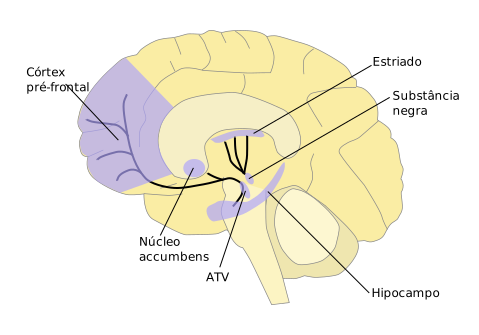
NIDA — National Institute on Drug Abuse; derivative work by Quasihuman · Dopamine pathways · Public domain · labels translated into Portuguese
How far this holds
My own reasoning from the mechanism. I found no study that had measured this in this form.
The three levels are a design model proposed by NormanWrote the book that gave affordance its name in design and formulated the three levels of emotional processing the site uses.One reference in this work:2013The design of everyday thingsSee in the bibliography →, not a neural finding: nobody has measured three layers in anybody’s brain. What has been measured are the loose pieces the model organises, each in its own literature.
Related neuromyths
-
The limbic system is the emotional brain, and it fights with the rational brain of the cortex.
The expression comes from a 1950s model that divided the brain into three evolutionary layers (reptilian, limbic systemAn inherited name for a group of structures — amygdala, hippocampus, neighbours — that the design literature still treats as a single block. Neuroscience does not treat it that way, because there is no anatomical boundary and no common function, and each of these structures does different things.See it in Emotion →See in the glossary → and rational) and that neuroanatomy has abandoned: the structures on that list don’t form a single functional system, and several of them take part in things that have nothing emotional about them. The amygdalaTwo small structures in the temporal lobe that decide, in milliseconds, whether something is a threat or an opportunity. They respond to your screen before any conscious judgement about it.See it in Emotion →See in the glossary → is involved in decision under risk and in attention; the hippocampusThe structure that turns recent experience into lasting memory. Everything your interface asks the person to remember tomorrow passes through it today.See it in Memory →See in the glossary →, in navigation and memory of any kind. The term survives out of convenience, and this site uses it in that loose sense. There is no emotional floor fighting a rational floor for the wheel. For whoever designs, this means there isn’t one screen for emotion and another for reason, but the same screen arriving first at the fastest circuit.
-
There is a fast pathway that takes fright straight to the body, without passing through the cortex.
The idea of the subcortical “low road” comes from Joseph LeDoux’s work on conditioned fear in rats, and LeDoux himself went on to defend a much narrower formulation in humans: the fast circuits trigger defence responses, and that isn’t the same as feeling fear. Feeling requires the cortex and is built afterwards. For whoever designs, the difference is practical. You can claim that the screen triggered a fast response; you can’t claim what the person felt.
Valence and arousal
Two measures account for any reaction: how much it pleases and how much it activates.
Any affective reaction can be described by two dimensions, valence, which runs from pleasure to displeasure, and arousal, which measures intensity, in the circumplex model RussellFormulated the circumplex model of affect: valence and arousal as the two dimensions that describe any emotional state.2 references in this work:1980A circumplex model of affect2003Core affect and the psychological construction of emotionSee in the bibliography → proposed in 1980 and reformulated as core affect in 2003. This model is usually cited the opposite way from what its author defends. Russell is one of the founders of the psychological construction of emotion, and his argument is that an emotional episode is assembled each time, not triggered by a circuit dedicated to “fear” or to “joy”. The two dimensions are the raw material of the emotional episode, not the mark of a circuit dedicated to it. In design, they determine how urgent, attractive or uncomfortable an element is. A flashing red button generates high arousal and calls immediate attention at the visceral level, but without care it triggers discomfort, negative valence; a gentle micro-animation on click conveys success, positive valence, and moves on to the behavioural level, encouraging the action to be repeated.
How far this holds
What this part claims was measured this way, and the studies are in the bibliography.
The two dimensions come from analysing how people group emotion words and rate photographs, on a scale. It’s a measure of declared judgement, not of physiology. And this chapter cites two schools that disagree. Jaak PankseppMapped the basic emotional systems humans share with other mammals, including the seeking circuit.One reference in this work:1998Affective neuroscienceSee on Wikipedia ↗See in the bibliography → defends dedicated emotional circuits; RussellFormulated the circumplex model of affect: valence and arousal as the two dimensions that describe any emotional state.2 references in this work:1980A circumplex model of affect2003Core affect and the psychological construction of emotionSee in the bibliography → and Lisa Feldman BarrettLed the review that dismantles reading emotion from facial expression: the same face does not mean the same thing everywhere.One reference in this work:2019Emotional expressions reconsidered: challenges to inferring emotion from human facial move…See on Wikipedia ↗See in the bibliography → defend that emotion is constructed episode by episode. Both sides agree that the reaction arrives before judgement, which is the part the chapter needs, but anyone who goes looking will find the fight, and it is real.
Emotional memory
What stirs emotion stays; the rest competes with that.
As soon as the amygdalaTwo small structures in the temporal lobe that decide, in milliseconds, whether something is a threat or an opportunity. They respond to your screen before any conscious judgement about it.See it in Emotion →See in the glossary → activates, it interacts with the hippocampusThe structure that turns recent experience into lasting memory. Everything your interface asks the person to remember tomorrow passes through it today.See it in Memory →See in the glossary → to prioritise emotionally charged memories, in the modulation McGaughShowed how the amygdala modulates the consolidation of memories of emotionally intense events.One reference in this work:2004The amygdala modulates the consolidation of memories of emotionally arousing experiencesSee in the bibliography → mapped in 2004. A neutral event tends to fade in hours or days; an experience marked by fear, surprise or pleasure has a much better chance of getting through consolidation and settling in the cortex as a long-term memoryWhat the person still knows tomorrow of what they saw today. It does not live in one place only: it forms through the hippocampus and, over time, comes to live spread across the cortex.See it in Memory →See in the glossary →. At the reflective level, those memories form the opinion about the product, “this site made me feel safe”, “that app made me anxious”, and they are what decide returns and recommendations.
How far this holds
The structures and the numbers are well established, but they were measured outside an interface. The jump from here to the screen is mine.
The modulation of consolidation by the amygdala is McGaughShowed how the amygdala modulates the consolidation of memories of emotionally intense events.One reference in this work:2004The amygdala modulates the consolidation of memories of emotionally arousing experiencesSee in the bibliography →’s work (2004), measured with photographs of unpleasant content and a recall test days later. The emotion there is the photo’s, not that of a flow that doesn’t close.
Prefrontal regulation
The brake arrives after the fright, and it’s what decides whether the person clicks.
Although the amygdalaTwo small structures in the temporal lobe that decide, in milliseconds, whether something is a threat or an opportunity. They respond to your screen before any conscious judgement about it.See it in Emotion →See in the glossary → reacts fast, the prefrontal cortexThe region behind the forehead, where the person decides, plans and sustains attention. It keeps one thing in focus at a time and inhibits the rest: it is where the bottleneck of conscious decision usually tightens.See it in Memory →See in the glossary →, especially the orbitofrontal cortexIt sits right behind the eyes and assigns value: whether the thing is worth it, whether it is pleasant, how much it costs in effort. It answers before the person knows they asked.See it in Emotion →See in the glossary → and ventromedial prefrontal cortexIt makes the global judgement, the final opinion on an entire experience, not on each moment of it. It is because of it that the person sums up a ten-screen flow in a single sentence.See it in Emotion →See in the glossary → areas, comes into play right after to assess the context and moderate the intensity of the response. At this behavioural level, the person doesn’t just feel an impulse: they think “should I click?”, “is this alert trustworthy?”. A successful design harmonises the three layers, immediate attraction, clear functionality and positive reflection. That brake works with what the screen gives it to reappraise, and that’s why an alert that says what is at stake has a chance of being heeded, while one that only flashes becomes noise.
How far this holds
The structures and the numbers are well established, but they were measured outside an interface. The jump from here to the screen is mine.
The orbitofrontal cortexIt sits right behind the eyes and assigns value: whether the thing is worth it, whether it is pleasant, how much it costs in effort. It answers before the person knows they asked.See it in Emotion →See in the glossary → and ventromedial prefrontal cortexIt makes the global judgement, the final opinion on an entire experience, not on each moment of it. It is because of it that the person sums up a ten-screen flow in a single sentence.See it in Emotion →See in the glossary → areas were mapped along two lines. On one are the patients with lesions in those regions, which is Damasio’s material (1994). On the other, the emotional reappraisal tasks, in which the person looks at an unpleasant image and is instructed to reinterpret it while the scanner records. No product screen, no flow, no purchase decision.
Related neuromyths
-
Self-control is a fuel that runs out: whoever has already decided a lot during the day decides worse at the end of it.
It’s called ego depletion theory, and it’s the best-known case of a finding that didn’t survive replication. Twenty-three laboratories redid the experiment with the protocol registered before running it, totalling 2,141 participants. The literature published up to then indicated a medium-sized effect: in a line of a hundred tired people and a hundred rested ones, you can guess which group someone came from about 67 times out of a hundred. In the replication the size fell to 51 out of a hundred, which is the same as tossing a coin. In numbers, d = 0.04, against the earlier d = 0.62 (HaggerCoordinated the replication of ego depletion across 23 laboratories, with the protocol registered beforehand, and did not find the effect.One reference in this work:2016A multilab preregistered replication of the ego-depletion effectSee in the bibliography → et al., 2016).
Isso não quer dizer que ninguém cansa. Quer dizer que o cansaço de decidir não tem o formato de tanque que se esvazia, e que “peça o difícil de manhã” está apoiado em pouca coisa. O que continua de pé é mais banal e mais útil: o custo está no número de decisões que a interface transfere para quem usa, não na hora do dia em que ela transfere. Quem quiser o número desse custo encontra em Hick–Hyman lawCut what does not change the decision. Splitting into steps does not reduce the cost of choosing, it spreads it.Open the law →, que mede o tempo de cada escolha, e em Cognitive load theoryAdd up everything the screen asks for at once, and take away half.Open the law →, que mede o que sobra depois delas.
The other parts of the engine