viés
Salience bias
People tend to focus on items or information that are more prominent and ignore those that stand out less.
Highlight one thing per screen. Two is already none.
Attention does not choose what is important, it chooses what pops out. And what pops out steals the turn from everything else, including things the person was deliberately looking for. Christopher Christopher ChabrisRan, with Simons, the invisible gorilla experiment, which measures how much goes unseen when attention is busy with something else.One reference in this work:2010The invisible gorilla: and other ways our intuitions deceive usSee on Wikipedia ↗See in the bibliography → and Daniel Simons became known for the gorilla experiment: 56% of participants, busy counting basketball passes, fail to see a person in a gorilla suit walk across the scene. The useful side of this for design is also the dangerous side. Emphasis works because it is scarce, and when everything on the screen shouts the effect cancels out completely.
What the brain does with it
The biological mechanism behind the effect, and how much of it was actually measured.
Perceptually salient stimuli — vivid colour, movement, contrast, novelty — mobilise exogenous attention, the kind that does not depend on intention. The superior colliculusA station in the brainstem that pulls the gaze towards what moves or contrasts, before the person decides to look. It is that reflex that every visual highlight hijacks.See in the glossary → commands the reflexive shift of gaze and the frontoparietal circuitsThe pair that supports working memory: the prefrontal cortex holds the information active while the parietal lobe keeps track of where things are.See it in Memory →See in the glossary → take part in selecting what gets in, and that is well established in attentional capture tasks, as CorbettaOne reference in this work:2002Control of goal-directed and stimulus-driven attention in the brainSee in the bibliography → and Shulman reviewed in 2002 and KrauzlisOne reference in this work:2013Superior colliculus and visual spatial attentionSee in the bibliography → and colleagues in 2013. What was measured were targets on laboratory screens, not banners on a checkout page, and the link to what happens on a page is mine.
The body this law presumes
Who it was measured on, and what changes when the body on the other side is another.
The bias says that one highlighted thing steals attention from the others, and that presupposes an eye sweeping the screen. For whoever navigates by screen reader there is no highlighting, there is order and emphasis declared in the markup, and both are harder to change later, because they live in the structure and not in the appearance.
How design translates it
What to do with it on a screen, without turning a finding into a rule.
How to measure this in your product
Used with intention, salience highlights what matters: an error, a call to action. When everything shouts, nothing stands out. Schiphol airport, in Amsterdam, had a cleanliness problem in the men’s toilets and solved it by sticking the drawing of a fly inside each urinal, near the drain. Nobody was told to aim at it. The mess dropped, according to the airport itself, which never published the test, and the plausible explanation is that a salient target draws the aim before the person decides to aim. The fly does the whole job with no sign, no text and without asking for anything.
Onde vira manipulação
The same lever, pointed at the person on the other side.
Manipulating salience hides the cancel button and highlights the promotional path. It is the most banal and most effective dark pattern.
Where it breaks
Where the law does not hold, holds less, or holds in reverse.
Emphasis works by contrast with the rest, and contrast is a resource that runs out. The reverse also breaks, because the most salient item is not the most important one, it is the loudest, and a screen designed around salience tends to optimise what converts, not what the person came to do. It is always worth asking who is served by what is being highlighted.
Related neuromyths
What gets said about this concept out there, and what the evidence actually shows.
-
The gorilla experiment proves that an eye-catching element is always seen.
It proves the opposite. The gorilla crosses the entire scene, and more than half the people do not see it, because they are counting passes. It was 56% in the published study, and half even in the popular version, in which it stops in the middle of the screen and beats its chest for nine seconds. Physical salience does not beat attention already occupied with another task, because what decides is where the person is looking, not the size of what you put on the screen.
Um caso
A real product where this showed up, with what happened and where to check it.
The big button subscribes; the small link declines
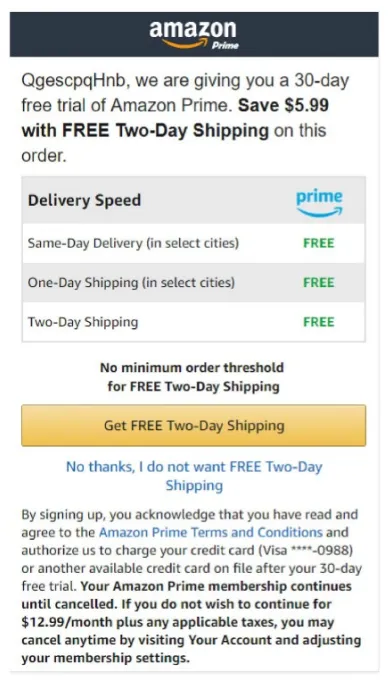
FTC · amended complaint, page 32 (Amazon interface) · Uso editorial
In 2023 the FTC, the United States consumer protection agency, sued Amazon for leading people to subscribe to Prime without realising it. According to the complaint, the button to complete the purchase did not say clearly that the person was signing up for the subscription, and the option to buy without signing up was a hard-to-find link, worded as a refusal of free shipping. In September 2025 Amazon settled without admitting guilt, with a one billion dollar fine and one and a half billion in refunds to about 35 million people. The order requires a clear and visible button to decline Prime. The screen descriptions are the FTC’s allegations. What the regulator prescribed was salience. Who is served by what is being highlighted?
Experimente
A piece to check in your own body what the text has just claimed.
How many things can call for attention at the same time
Increase the number of highlighted items, one at a time, and notice from how many onwards you can no longer point to which is “the” important item.
A single point of attention: the highlight works.
With one highlight, the eye goes straight there. With four, you start comparing. With twelve, there is no highlight at all, only noise. Salience is a zero-sum resource: every new element that shouts steals attention from the ones that were already shouting.
Neighbouring concepts
Structures linked by a bridge of my own
- frontoparietal circuits
- superior colliculus
Sibling concepts
Fontes
Enunciado in the current form of the bias. The book by Chabris and Simons, 2010, is the reading the text discusses, and not the origin of the sentence.
- CHABRIS, C.; SIMONS, D. The invisible gorilla: and other ways our intuitions deceive us. New York: Crown, 2010. Source
Leitura complementar: Salience (neuroscience) Wikipedia em inglês
A página cobre a saliência de forma ampla; o viés aparece numa subseção, não como tema principal.