lei
Law of uniform connectedness
People tend to perceive elements connected by lines or continuous shapes as part of the same group.
An explicit line between two elements is usually enough, even against distance.
A line linking two elements is one of the hardest grouping signals to ignore. Stephen PalmerFormulated two Gestalt principles Wertheimer had not written: common region and uniform connectedness.2 references in this work:1992Common region: a new principle of perceptual grouping1994Rethinking perceptual organization: the role of uniform connectednessSee in the bibliography → and Irvin Rock described it in 1994, seventy years after the classic Gestalt laws, and the finding is that explicit connection can beat proximity: two distant dots joined by a stroke read as a pair, even next to dots that are closer to each other. It is what makes a timeline, a flowchart or the stroke that links a label to the point it describes work.
What the brain does with it
The biological mechanism behind the effect, and how much of it was actually measured.
Elements linked by a line, a curve or a continuous visual path are perceived as belonging to the same group. Palmer and Rock (1994) proposed that this connection comes before the other cues in the order of processing, which is different from being stronger than all of them, and confusing the two is common. No study has established a fixed ranking among the Gestalt cues: dominance depends on arrangement, scale and contrast. Linking by continuous contour is resolved in V1The first area of the brain, right at the back of the head, to receive what the eye sent. It is where the image becomes contrast, edge and orientation, before you recognise what you are looking at.See it in Senses and attention →See in the glossary → and V2The area right after V1. It joins the edges V1 detected, separates figure from ground and decides which elements form a group, all of it before you notice you looked.See it in Senses and attention →See in the glossary →, where neurons respond to aligned elements as if they were a single object, and RoelfsemaOne reference in this work:2006Cortical algorithms for perceptual groupingSee in the bibliography →, in 2006, separates that grouping into two speeds, one immediate and another that depends on attention and takes longer. Those findings come from contours assembled in the laboratory, and carrying them over to the line that links label and point on a chart is my bridge.
The body this law presumes
Who it was measured on, and what changes when the body on the other side is another.
The line that links two elements exists in the drawing. For whoever navigates by screen reader it does not exist, and, if the relationship is not declared in the markup, it never reaches the person using it.
How design translates it
What to do with it on a screen, without turning a finding into a rule.
How to measure this in your product
In a form, connecting related fields with subtle lines, or organising them in a continuous flow like a timeline, makes the sequence easier to read and spares the person from holding the relationship in their head, because it signals that those elements form a unit. The stroke that links a label to the point it describes on a chart is the clearest case, because without it the person has to guess which point the label belongs to.
Where it breaks
Where the law does not hold, holds less, or holds in reverse.
Because it is a hard signal to ignore, it is the one that misleads most when it happens by accident. An unintended alignment connects unrelated things, and the person believes the line before reading the label.
Um caso
A real product where this showed up, with what happened and where to check it.
A dot or a stroke, and who changes trains
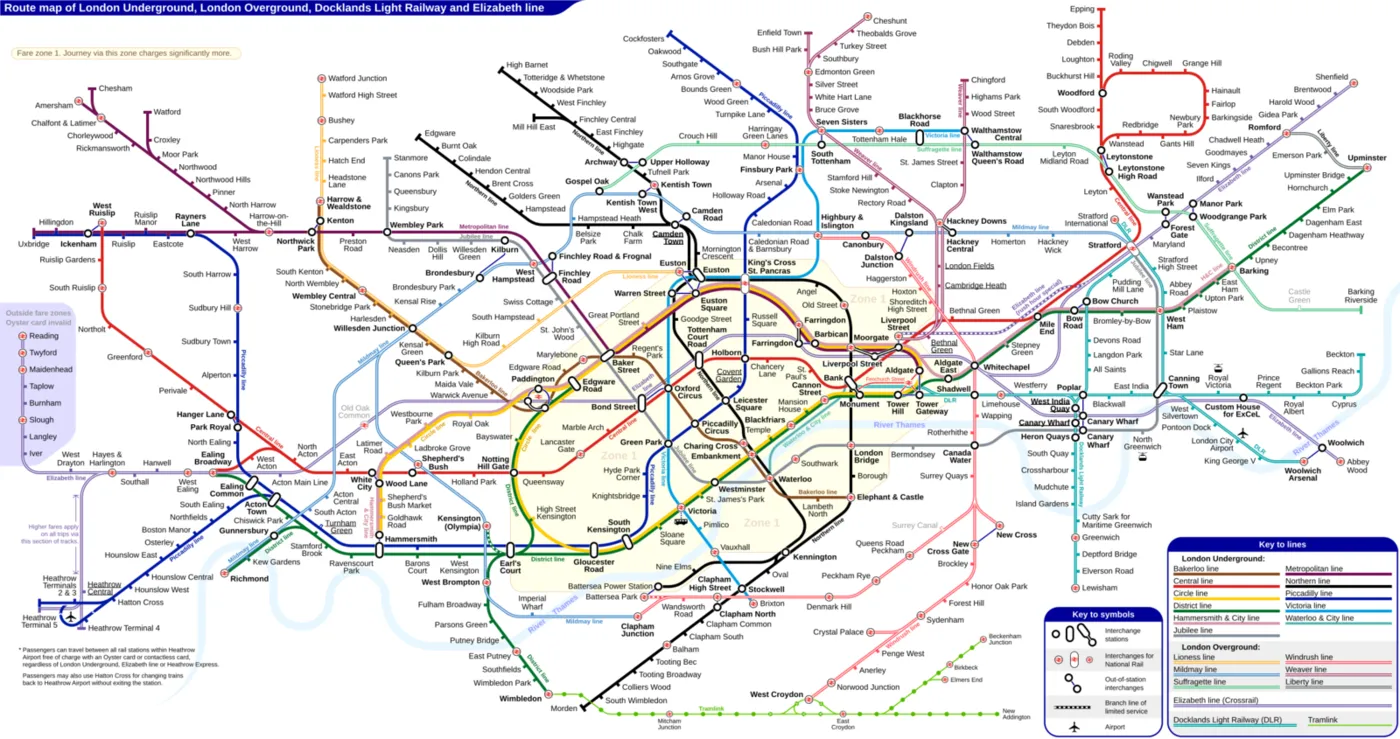
Diagrama de Sameboat · via Wikimedia Commons · CC BY-SA 4.0
The London Underground map draws an interchange in two ways. Either the lines cross at a single circle, or two circles appear joined by a stroke. Zhan Guo cross-referenced the map with 18,894 recorded journeys and showed that this drawing changes people’s routes. Stations drawn with the stroke, like Baker Street, seem harder to change at than they are, and stations drawn as a single dot, like Oxford Circus, seem easier, even with worse passageways. The model estimates that the stroke drives away hundreds of interchanges a day at Baker Street, and that the dot attracts even more at Victoria and at Oxford Circus. Two circles joined by a line say “two connected things”, and one circle says “a single thing”. People act on that reading, not on the real passageway. The drawing of the interchange changed the route of people who travel there every day, and the same thing happens with a line between two elements on a screen.
Experimente
A piece to check in your own body what the text has just claimed.
A line beats distance
The six dots sit in two trios separated by a gap, and it is the gap that makes you read two groups. Now connect the two dots at the ends and see what happens to that reading.
You read two groups of three, defined by the gap in the middle.
The explicit connection beat proximity in this arrangement. That does not make it the strongest Gestalt cue, because there is no fixed ranking among them: what Palmer and Rock proposed was precedence in the order of processing, and whichever wins on one screen can lose on the next.
Neighbouring concepts
Structures linked by a bridge of my own
Sibling concepts
Fontes
Enunciado citado de Palmer; Rock, 1994.
- PALMER, S. E.; ROCK, I. Rethinking perceptual organization: the role of uniform connectedness. Psychonomic Bulletin & Review, v. 1, n. 1, p. 29-55, 1994. DOI
Leitura complementar: Law of Uniform Connectedness Laws of UX em inglês