lei
Law of common region
Elements tend to be perceived as grouped if they share a visibly bounded area.
A shared border or background can group even against distance.
Draw a border around a handful of elements and they become a group, even if they are far from one another. Stephen PalmerFormulated two Gestalt principles Wertheimer had not written: common region and uniform connectedness.2 references in this work:1992Common region: a new principle of perceptual grouping1994Rethinking perceptual organization: the role of uniform connectednessSee in the bibliography → described this principle in 1992 and showed something useful: in the arrangements he tested, common region beat proximity. Elements spread apart inside the same box are read as a set; elements right next to each other, but in different boxes, are read as separate. It is the cheapest tool there is for reorganising a screen without moving anything.
What the brain does with it
The biological mechanism behind the effect, and how much of it was actually measured.
The mechanism studied here is border ownership: already in the secondary visual cortex, V2The area right after V1. It joins the edges V1 detected, separates figure from ground and decides which elements form a group, all of it before you notice you looked.See it in Senses and attention →See in the glossary →, there are neurons that encode which side of a contour the object is on, and that is what makes a shared background read as a container and not as a blot. The border does not bring the elements inside closer together, it separates them from what is outside. That is why common region groups even when the elements are far from one another. The bridge is fragile on both sides. Palmer himself showed that grouping by common region depends on perceived depth, which places it after V2, not in it. Border ownership explains how a border becomes a container, and does not explain grouping on its own.
The body this law presumes
Who it was measured on, and what changes when the body on the other side is another.
A shared border or background groups for whoever sees the screen. For whoever navigates by screen reader, that grouping only exists if it is declared in the markup, with a field group and a name that says what that group is made of. Drawing the frame is not enough.
How design translates it
What to do with it on a screen, without turning a finding into a rule.
How to measure this in your product
In a checkout, putting “Shipping” and “Payment methods” inside the same bounded block says that this is a group, without moving anything. One border, one background, and three scattered fields become a single subject.
Where it breaks
Where the law does not hold, holds less, or holds in reverse.
Box inside box inside box: each new frame weakens the ones before it. When everything has a border, no border groups.
Related neuromyths
What gets said about this concept out there, and what the evidence actually shows.
-
There is a fixed hierarchy among the Gestalt principles.
No study has established a ranking. The cues combine and cancel each other out according to the relative strength of each one in the specific arrangement, what wins on one screen loses on the next, and the only way to know is to look at yours.
Um caso
A real product where this showed up, with what happened and where to check it.
The race that ended up inside the instructions column
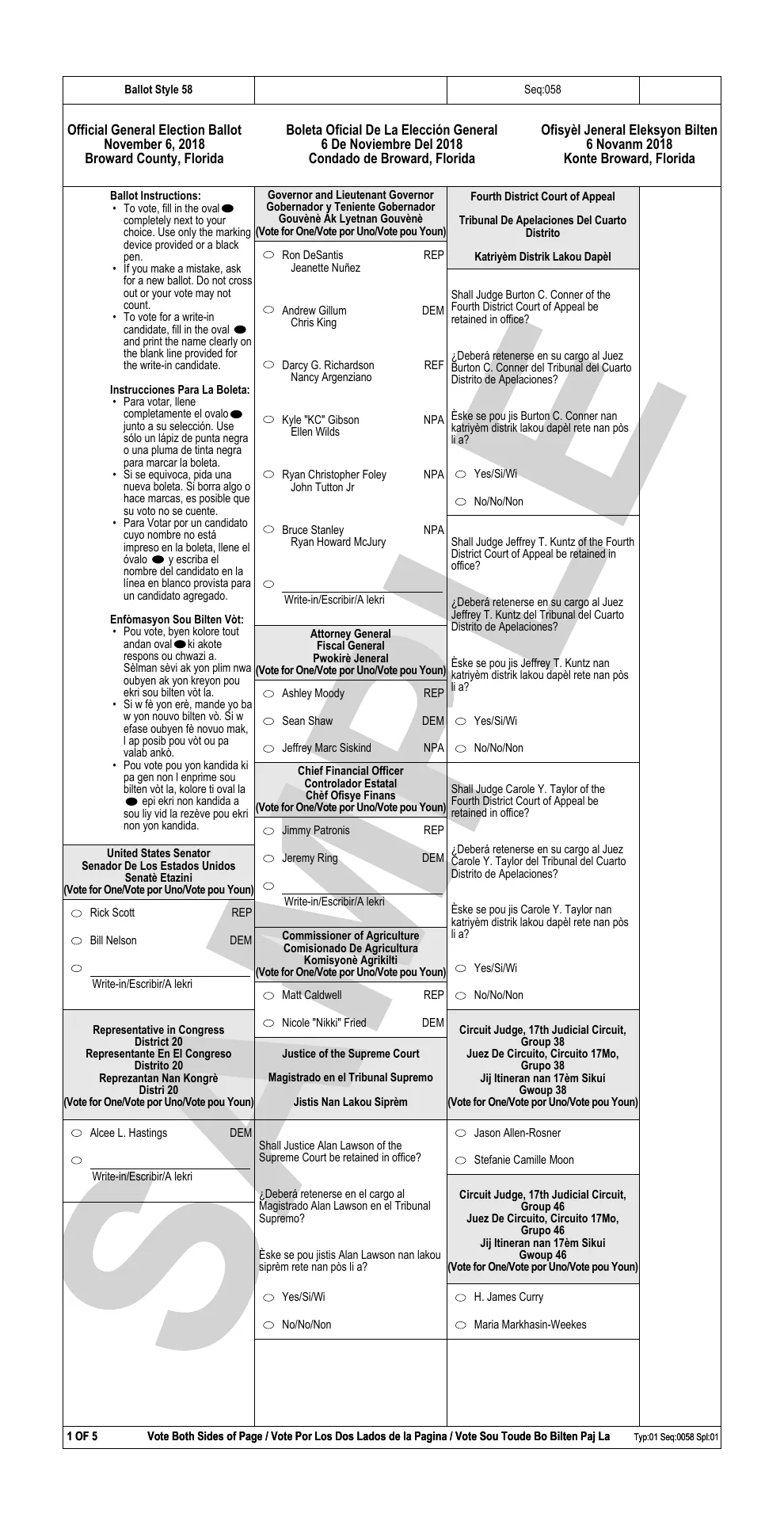
Broward County Supervisor of Elections · official sample ballot, via Ballotpedia · Registro público da Flórida
On the Broward ballot, in Florida, in 2018, the first column carried the voting instructions in three languages, and the Senate race sat beneath them, inside the same column. The other races started in the middle column. A 2007 federal guideline already advised against that arrangement, because in testing voters skipped whatever came right after the instructions. That is what happened. Statewide, 1.10% of voters left the Senate blank, against 0.64% for governor, and Broward, with 8.8% of the votes, concentrated about a third of those blanks. The election was decided by 10,033 votes, and the study’s authors do not claim that the ballot decided it. What they show is common region at work. The column is a box, what is inside it is read as part of it, and a race inside the instructions column became an instruction for whoever was reading fast.
Experimente
A piece to check in your own body what the text has just claimed.
A border weighs more than distance
Click the button to draw a frame around each group. No element moves — only the border appears.
The distance between the elements is identical in both states. All that changes is a 1px border, and in this arrangement it overrides proximity, as it did in the arrangements Palmer tested. In another arrangement the order can reverse, because there is no fixed hierarchy among the principles.
Neighbouring concepts
Structures linked by a bridge of my own
Sibling concepts
Fontes
Enunciado citado de Palmer, 1992.
- PALMER, S. E. Common region: a new principle of perceptual grouping. Cognitive Psychology, v. 24, n. 3, p. 436-447, 1992. DOI
Leitura complementar: Law of Common Region Laws of UX em inglês