efeito
Serial position effect
Users are more likely to remember the first and last items in a list than the items in the middle.
What needs to be remembered goes at the beginning or the end of the list.
Of a list, the ends are what remain. What came first stays because it had time to be processed calmly, and what came last stays because it is still in active memory when the person stops reading. The middle is what evaporates. Hermann EbbinghausMeasured his own memory for years, with nonsense syllables, and drew the forgetting curve and the serial position effect.One reference in this work:1885Über das GedächtnisSee in the bibliography → arrived at this at the end of the nineteenth century by memorising nonsense syllables on himself, to measure memory without the interference of meaning. The curve in the form it circulates in today, with free recall and lots of people, is Bennet Murdock Jr.Measured the serial position effect in free recall: the beginning and the end of a list survive, the middle vanishes.One reference in this work:1962The serial position effect of free recallSee in the bibliography →’s, from 1962, and it is the one the exercise on this page reproduces. In an interface, the consequence is direct: in a menu, a carousel or a list of plans, the middle position is the weakest position there is.
What the brain does with it
The biological mechanism behind the effect, and how much of it was actually measured.
They are two effects with separate mechanisms. Primacy depends on the first items having received more rehearsal and entered long-term memoryWhat the person still knows tomorrow of what they saw today. It does not live in one place only: it forms through the hippocampus and, over time, comes to live spread across the cortex.See it in Memory →See in the glossary →, and it is that half that involves the hippocampusThe structure that turns recent experience into lasting memory. Everything your interface asks the person to remember tomorrow passes through it today.See it in Memory →See in the glossary →. Recency is something else. The last items are still active when the person answers, in a short-term store that does not pass through there. The cleanest proof of that dissociation comes from neuropsychology, with hippocampal-lesion patients who lose primacy and keep recency intact. For whoever designs, the consequence is practical: the beginning of a list needs repetition to last, and its end lasts on its own, but only until the next screen.
This law seems not to change with the body
Who it was measured on, and what changes when the body on the other side is another.
The curve holds for a list seen and for a list heard, but not in the same way in both. WrightCompared serial position in the visual and auditory modalities and showed that the curves move in opposite directions over time.One reference in this work:1998Auditory and visual serial position functions obey different lawsSee in the bibliography → measured the two modalities with increasing intervals between seeing and answering, and the curves move in opposite directions. In the visual, the beginning of the list gains strength and the end loses it; in the auditory, the reverse happens. It remains to say in whom: the visual half was measured in capuchin monkeys, humans and pigeons, and the auditory half in rhesus monkeys. Whoever designs for a screen reader is probably in the auditory regime, where what was said last is what stays most, and the leap from the monkey to the screen read aloud is mine.
How design translates it
What to do with it on a screen, without turning a finding into a rule.
How to measure this in your product
In a product carousel or a menu, the item that needs to be remembered goes at the beginning or at the end. The reverse also holds. Critical information hidden in the middle of a long list is information nobody will remember having seen.
Where it breaks
Where the law does not hold, holds less, or holds in reverse.
The effect is no justification for hiding information in the middle of the list. When the information is mandatory, like the final price, the deadline or the cancellation terms, it goes at one of the ends.
Um caso
A real product where this showed up, with what happened and where to check it.
The menu turned inside out
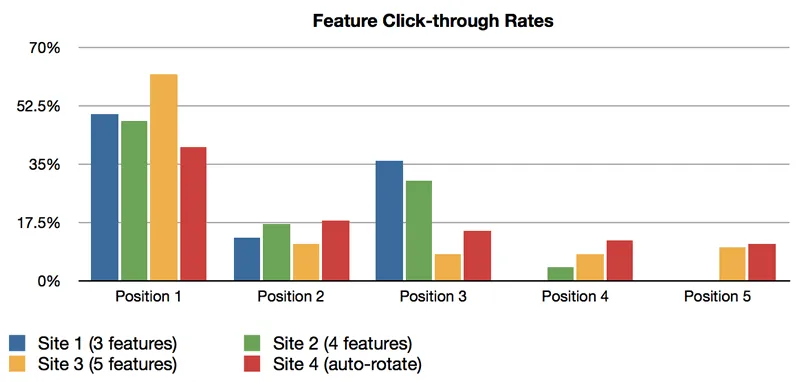
Erik Runyon · Carousel Interaction Stats · Uso editorial
In a café in central Tel Aviv, two researchers tested two versions of the menu, which differed only in the position of the items within each category. In the inverted version, the items at the ends swapped places with those in the middle. Each version stayed for fifteen days, with 459 orders on one and 492 on the other. Items placed at the beginning or the end of their category’s list were ordered up to twice as often, and on average took 55% of the orders, versus 45% when they were in the middle, which gives a gain of about 20%. Same item, same price, same description. The authors point out that primacy and recency were described for sequential presentation, and a menu is simultaneous, so the link to an on-screen list carries the same caveat. On screen the effect has a side the menu does not have. In a carousel on the University of Notre Dame’s home page, 84% of clicks went to the first slide, and the other four split the rest. There, there is no end of list to rescue the last item.
Experimente
A piece to check in your own body what the text has just claimed.
What you remember from a list
Click Show the list and twelve words will go by, one at a time. When it is over, write down the ones you remember, in any order, separated by commas, and check which positions they came from.
The list hasn’t gone by yet.
Almost everyone remembers more of the first and the last ones. The first had time to be rehearsed in the head; the last were still fresh. The middle is where information disappears, and it is where whatever nobody decided where to put usually ends up.
Neighbouring concepts
Structures linked by a bridge of my own
Sibling concepts
Fontes
Enunciado citado de Ebbinghaus, 1885.
- EBBINGHAUS, H. Über das Gedächtnis. Leipzig: Duncker & Humblot, 1885. Source
- DAYAN, E.; BAR-HILLEL, M. Nudge to nobesity II: menu positions influence food orders. Judgment and Decision Making, v. 6, n. 4, p. 333-342, 2011. DOI
Leitura complementar: Serial Position Effect Laws of UX em inglês