heurística
Availability heuristic
People judge how frequent an event is by how easily they can recall examples of it.
Fix the worst case before the average case: it is the vivid that stays in memory.
We judge how common something is by how easy it is to remember an example. Amos Amos TverskyRan, with Kahneman, the experiments that founded behavioural economics: anchoring, availability, the law of small numbers.3 references in this work:1973Availability: a heuristic for judging frequency and probability1971Belief in the law of small numbers1974Judgment under uncertainty: heuristics and biasesSee on Wikipedia ↗See in the bibliography → and Daniel Daniel KahnemanHalf the work this catalogue cites passes through him: anchoring, availability, the endowment effect, peak–end, the two systems.5 references in this work:2011Thinking, fast and slow1966Pupil diameter and load on memory1993When more pain is preferred to less: adding a better end1990Experimental tests of the endowment effect and the Coase theorem1991Anomalies: the endowment effect, loss aversion, and status quo biasSee on Wikipedia ↗See in the bibliography → described this shortcut in 1973, and it works well most of the time: what happens a lot usually comes to mind fast. It fails when something else makes remembering easy, like a recent or emotionally strong episode. A plane crash seems more frequent than it is because every one of them makes the news. In an interface, what the person saw last takes that place of “seems common”, and that is why “recently viewed” reduces the insecurity of someone who is deciding.
What the brain does with it
The biological mechanism behind the effect, and how much of it was actually measured.
It is a shortcut based on the fluency with which information is retrieved: when judging probability or importance, the person considers the examples that come to mind most easily, even if they are not representative. The finding is from the 1970s and is among the most replicated in the field. The explanation is cognitive and complete in itself, the ease of retrieving is the mechanism, and not the symptom of something else. Retrieving from long-term memoryWhat the person still knows tomorrow of what they saw today. It does not live in one place only: it forms through the hippocampus and, over time, comes to live spread across the cortex.See it in Memory →See in the glossary → depends on the hippocampusThe structure that turns recent experience into lasting memory. Everything your interface asks the person to remember tomorrow passes through it today.See it in Memory →See in the glossary → and the medial temporal cortexThe inner part of the temporal lobe, hippocampus and surroundings, through which fact and episode pass to become lasting memory. Its role is temporary: over time the memory ends up stored in the cortex and stops depending on this region.See it in Memory →See in the glossary →, as SquireOne reference in this work:1991The medial temporal lobe memory systemSee in the bibliography → and Zola-Morgan reviewed in 1991. That was measured in memory tasks, and not in probability judgement, and the link to the heuristic is mine.
The body this law presumes
Who it was measured on, and what changes when the body on the other side is another.
What is available in the head depends on what the person saw before, and that comes from the media they consume and the stories that circulate where they live. One country’s vivid case is not another’s, and Brazilians overestimate muggings where the Japanese overestimate earthquakes.
How design translates it
What to do with it on a screen, without turning a finding into a rule.
How to measure this in your product
A person can judge an entire app by the single rare error that frustrated them, and that is why fixing the worst case pays more than polishing the average case. In the same way, a vivid testimonial generates more trust than an abstract statistic, precisely because it is easier to remember. Highlighting positive experiences and reducing one-off negative events matters more than the average suggests, because it is the vivid that stays.
Where it breaks
Where the law does not hold, holds less, or holds in reverse.
The heuristic distorts whoever designs in the same measure. The last support case you read is not the real frequency of the problem, and prioritising by recollection is prioritising by your memory, not by the pain of whoever uses it.
Um caso
A real product where this showed up, with what happened and where to check it.
Half a per cent that became the whole phone
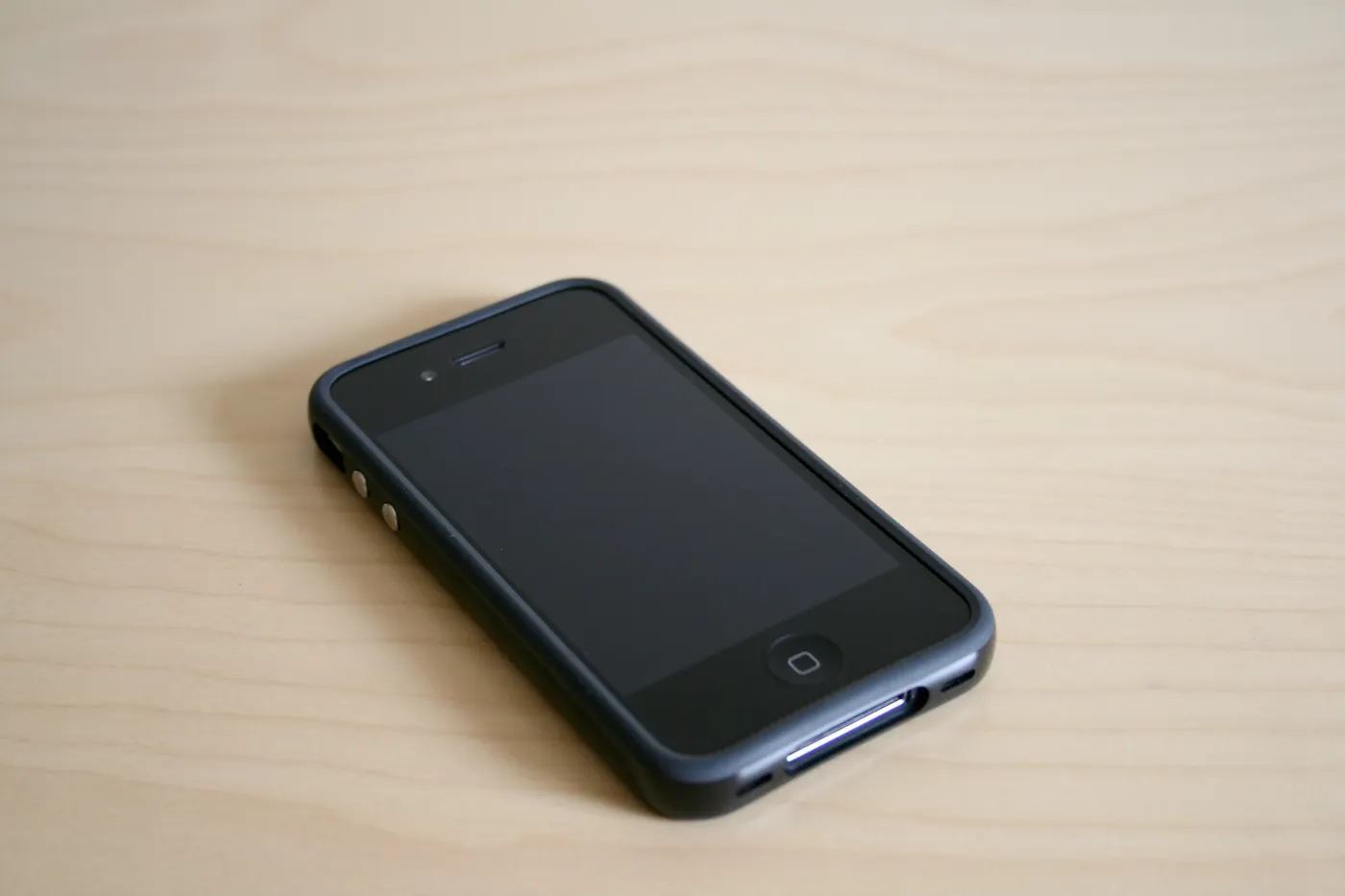
Foto de William Hook · via Wikimedia Commons · CC BY-SA 2.0
Three weeks after the launch of the iPhone 4, in 2010, with videos and headlines about the signal dropping when the phone was held by its side, Apple called a press conference. According to the numbers Steve Jobs presented, 0.55% of buyers had called support about the antenna or reception, the return rate was 1.7%, against 6% for the previous model, and the phone dropped less than one call more per hundred. Even so, Apple gave every buyer a free case. The perceived frequency of the defect did not come from the rate, it came from how easy it was to remember. A ten-second video and weeks of coverage weigh more than half a per cent. The numbers are the company’s own, chosen for the defence, and Consumer Reports had reproduced the defect in the laboratory that same week. The defect existed, and the memory of it was bigger than the defect. When your product fails in a way that is easy to tell, the rate is not going to defend you.
Experimente
A piece to check in your own body what the text has just claimed.
Two lists, the same alphabet
Write whatever comes to mind in each box, separated by commas. No looking anything up — the point is precisely what comes on its own.
Fill in both to compare.
Almost everyone produces more in the first box, and reality is the opposite. In a list of 267 thousand Portuguese words, 8,622 start with R and 32,401 have R as the third letter: almost four times as many. The difference is not in what exists, it is in how memory searches, which is by the start of the word. It is that ease of recall, not the real frequency, that becomes the estimate. It applies to whoever designs too. The last support case you read is not the real frequency of the problem.
Neighbouring concepts
Structures linked by a bridge of my own
Sibling concepts
Fontes
Enunciado citado de Tversky; Kahneman, 1973.
- TVERSKY, A.; KAHNEMAN, D. Availability: a heuristic for judging frequency and probability. Cognitive Psychology, v. 5, n. 2, p. 207-232, 1973. DOI
Leitura complementar: Heurística de disponibilidade Wikipédia