lei
Hick–Hyman law
The time it takes to make a decision increases with the number and complexity of the choices available.
Cut what does not change the decision. Splitting into steps does not reduce the cost of choosing, it spreads it.
Every option you put on the screen charges time from whoever has to choose, and it is not the time to read each one, it is the time to decide between them. William William Edmund HickMeasured decision time as a function of the number of alternatives, and found the logarithmic relation that bears his name.One reference in this work:1952On the rate of gain of informationSee on Wikipedia ↗See in the bibliography → and Ray HymanRefined Hick’s measurement the following year, which is why the law carries both names.One reference in this work:1953Stimulus information as a determinant of reaction timeSee in the bibliography → measured this cost in the 1950s and found a logarithmic relationship: each new option costs less than the one before, and a menu of twelve items does not cost twelve times that of one item. Here comes the part almost every UX resource gets wrong. By the same formula, splitting the list into steps does not reduce the cost of deciding, it increases it. Choosing between twelve at once costs log₂(13) ≈ 3.70; choosing between two categories and then between six costs log₂(3) + log₂(7) ≈ 4.39, almost twenty per cent more, because the decisions add up. So why do organised menus seem better? Because deciding is not the only thing the person does. They also need to find the option, and visual search grows linearly, not logarithmically. That is where grouping wins, but because of visual search, and not because of this law.
What the brain does with it
The biological mechanism behind the effect, and how much of it was actually measured.
The logarithmic relationship between number of alternatives and decision time is one of the most replicated behavioural findings in experimental psychology, measured since 1952 in dozens of laboratory tasks. What does not exist is a consensual neural mechanism to explain it. There are candidates, such as evidence accumulation models, and none of them closes the explanation. The law holds without any neural mechanism at all, and in a meeting it defends itself with measured decision time. Comparing alternatives requires selecting one at a time from among those in view, and the literature ties this selection to the frontoparietal circuitsThe pair that supports working memory: the prefrontal cortex holds the information active while the parietal lobe keeps track of where things are.See it in Memory →See in the glossary → (CorbettaOne reference in this work:2002Control of goal-directed and stimulus-driven attention in the brainSee in the bibliography → and Shulman, 2002). Nobody has measured these structures in a Hick task, and the link to the law is my own.
The body this law presumes
Who it was measured on, and what changes when the body on the other side is another.
The law measures the cost of choosing between alternatives that are all present at the same time and already known, and that is the source of the saving whereby doubling the options costs well under double the time. Whoever uses a screen reader does not have all the options available at once, they read them in a queue. Whoever uses magnification sees one slice of the screen at a time. In both cases a sequential search comes in before the decision, the total cost stops being logarithmic, and organising the list with navigable headings becomes worth more than cutting items from it.
How design translates it
What to do with it on a screen, without turning a finding into a rule.
How to measure this in your product
Use this law for the decision you cannot split: how many real alternatives the person needs to compare before acting. Five plans on a pricing page, four payment methods, three subscription tiers. That is where the cost lives, and the only way to lower it is to have fewer alternatives, not to hide them behind one more step. If you do split into steps, split for the right reason, which is the person finding things faster and carrying less from one screen to the next. The cost of deciding stays the same.
Onde vira manipulação
The same lever, pointed at the person on the other side.
Choice overload is used deliberately in privacy and cancellation flows: when consent is obtained through labyrinthine paths, the excess of options makes the person give up before finishing.
Where it breaks
Where the law does not hold, holds less, or holds in reverse.
The maths holds for a choice between equivalent, unknown options, which is the rare case. A well-labelled menu is not a choice between n things: it is a search, and whoever already knows what they want goes straight there without paying the logarithm. That is why cutting options does not always speed things up, and grouping, labelling and ordering usually pay off more than reducing. And the law even inverts, because hiding the option the person is looking for, to shorten the list, transfers the cost of the decision to the search, which is more expensive.
Related neuromyths
What gets said about this concept out there, and what the evidence actually shows.
-
Seven items at most in the menu, because working memory holds 7±2.
These are two laws glued together by mistake. The memory limit applies to what the person holds in their head; a menu is visible and can be reread. And the number the literature supports today is ~4, not 7. See George Armitage MillerWrote, in 1956, the magical number seven paper, which the field itself later corrected to about four.One reference in this work:1956The magical number seven, plus or minus twoSee on Wikipedia ↗See in the bibliography →’s law.
-
An excess of options paralyses: always reduce the alternatives.
The jam jar study that popularised the idea does not replicate consistently, and meta-analyses find an effect close to zero on average. What gets in the way is not the quantity itself, it is having no criterion for choosing between the options.
Um caso
A real product where this showed up, with what happened and where to check it.
The ninety seconds Netflix has
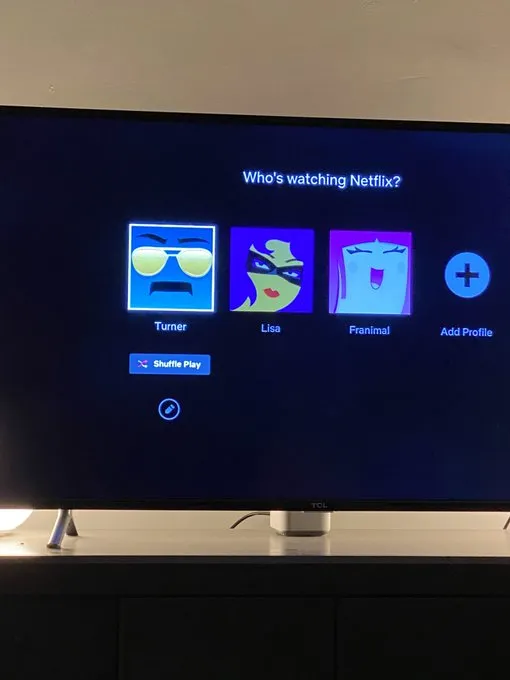
Netflix · photo published by TechCrunch, 28 April 2021 · Uso editorial
Two Netflix executives wrote, in 2015, that the company’s research suggests a limit for whoever is choosing what to watch. After sixty to ninety seconds, having looked at ten to twenty titles, the person loses interest, and the risk of abandoning the service rises considerably. The recommendation system exists to fit within that budget, and the same authors estimate that it is worth more than a billion dollars a year to the company. Netflix’s research puts a number on this law. The more similar options there are, the more expensive it is to decide, and the only way out is to reduce the set to be compared. In 2021 Netflix took this to the limit with the “Play Something” button, which starts playing a title based on the viewing history without asking for any choice at all. The ninety-second number comes from internal research, with no published method, and holds as an order of magnitude. The question it leaves for your product is how long the person can bear choosing before they leave.
Experimente
A piece to check in your own body what the text has just claimed.
What it costs to find an item in a list that grows
Choose how many options you want on screen and click Start. The name of an item will appear under “Look for” — find it and click it. The timer records how long you took. Repeat with more options and compare.
- Look for
- —
- Your time
- —
- Rodadas feitas
- 0
What you timed here was the time to find an item you already knew, and that cost rises with the number of options on screen. The law measures something else, the time to decide between alternatives, which grows with the logarithm of their number, and going from 2 to 4 weighs as much as going from 4 to 8. Breaking the list into two steps does not make that decision cheaper, because the two logarithms add up.
Neighbouring concepts
Structures linked by a bridge of my own
Sibling concepts
Fontes
Enunciado citado de Hick, 1952; Hyman, 1953.
- HICK, W. E. On the rate of gain of information. Quarterly Journal of Experimental Psychology, v. 4, n. 1, p. 11-26, 1952. DOI
- HYMAN, R. Stimulus information as a determinant of reaction time. Journal of Experimental Psychology, v. 45, n. 3, p. 188-196, 1953. DOI
Leitura complementar: Hick’s Law Laws of UX em inglês