estado
Flow state
The mental state in which a person performing some activity is fully immersed in a feeling of energised focus, full involvement and enjoyment in the process of the activity.
Raise the difficulty at the same speed the person improves.
The concept was born with Mihaly Mihaly CsikszentmihalyiDescribed the flow state and created the experience sampling method that measures it outside the laboratory.2 references in this work:1990Flow: the psychology of optimal experience1987Validity and reliability of the experience-sampling methodSee on Wikipedia ↗See in the bibliography →, studying people absorbed in what they were doing to the point of losing track of time, and it reached interface design through the door of games. The condition is a balance: challenge slightly above current skill. Below that comes boredom, above it comes anxiety. Whoever is in flow feels in control of the situation, and it is that feeling that holds the person in the task. The same mechanics that sustain learning sustain addiction, and the difference lies in what they are used for.
What the brain does with it
The biological mechanism behind the effect, and how much of it was actually measured.
The state is described consistently by those who live it: absorbed attention, loss of the sense of time, a sense of control. And the design recipe that comes out of it is solid, match difficulty to skill and return immediate feedback. The neural mechanism, that one is in open dispute, with mixed evidence and no settled reading. The attention the state describes is well mapped outside it, in the frontoparietal circuitsThe pair that supports working memory: the prefrontal cortex holds the information active while the parietal lobe keeps track of where things are.See it in Memory →See in the glossary → that hold a chosen focus against distraction, as CorbettaOne reference in this work:2002Control of goal-directed and stimulus-driven attention in the brainSee in the bibliography → and Shulman reviewed in 2002. That was measured in attention-orienting tasks, and not in anyone who was absorbed, and the link to flow is mine. The good news for whoever designs is that the recipe does not depend on settling the dispute.
The body this law presumes
Who it was measured on, and what changes when the body on the other side is another.
Flow presupposes sustained attention and some control over the task, and not every head delivers both in the same way. GrotewielCompared university students with and without ADHD and found the opposite of common sense: less flow and more hyperfocus, which is another state.One reference in this work:2023Experiences of hyperfocus and flow in college students with and without attention deficit…See in the bibliography → and colleagues compared university students with and without ADHD and found the opposite of what common sense supposes: those with ADHD report less flow and more hyperfocus, a state that looks like flow from the outside, but which is hard to leave when one has to. Designing rising difficulty to lead someone into flow assumes a control over entry and exit that not everyone has, and whoever is interrupted all the time at work never reaches the point where flow would begin.
How design translates it
What to do with it on a screen, without turning a finding into a rule.
How to measure this in your product
Clear goals, immediate feedback and challenge in step with the skill of whoever is there: those are the three conditions, and the third is the one that takes work. Removing distraction helps and is not a condition, it is what allows the concentration the state requires. A language app that repeats the same level for weeks bores; one that skips three levels at once frustrates, and in both cases the person leaves. The progression needs to be gradual and coherent for them to be able to enter and stay, and the exit also needs to exist, with a clear end of session and a way to stop without losing what was done.
Where it breaks
Where the law does not hold, holds less, or holds in reverse.
Flow is the favourite argument of whoever designs to retain instead of to serve. A flow with no natural exit point traps, and that shows up on the day the person tries to leave and cannot find where.
Related neuromyths
What gets said about this concept out there, and what the evidence actually shows.
-
In flow the brain works at peak activity.
The hypothesis with the most traction proposes the opposite: reduced prefrontal cortexThe region behind the forehead, where the person decides, plans and sustains attention. It keeps one thing in focus at a time and inhibits the rest: it is where the bottleneck of conscious decision usually tightens.See it in Memory →See in the glossary → activity, which is what would relieve self-monitoring and the sense of time. The evidence is mixed and the question is open; whoever asserts either side is choosing in an unresolved dispute.
Um caso
A real product where this showed up, with what happened and where to check it.
The exercise at the edge of what you know, and the flow with no door
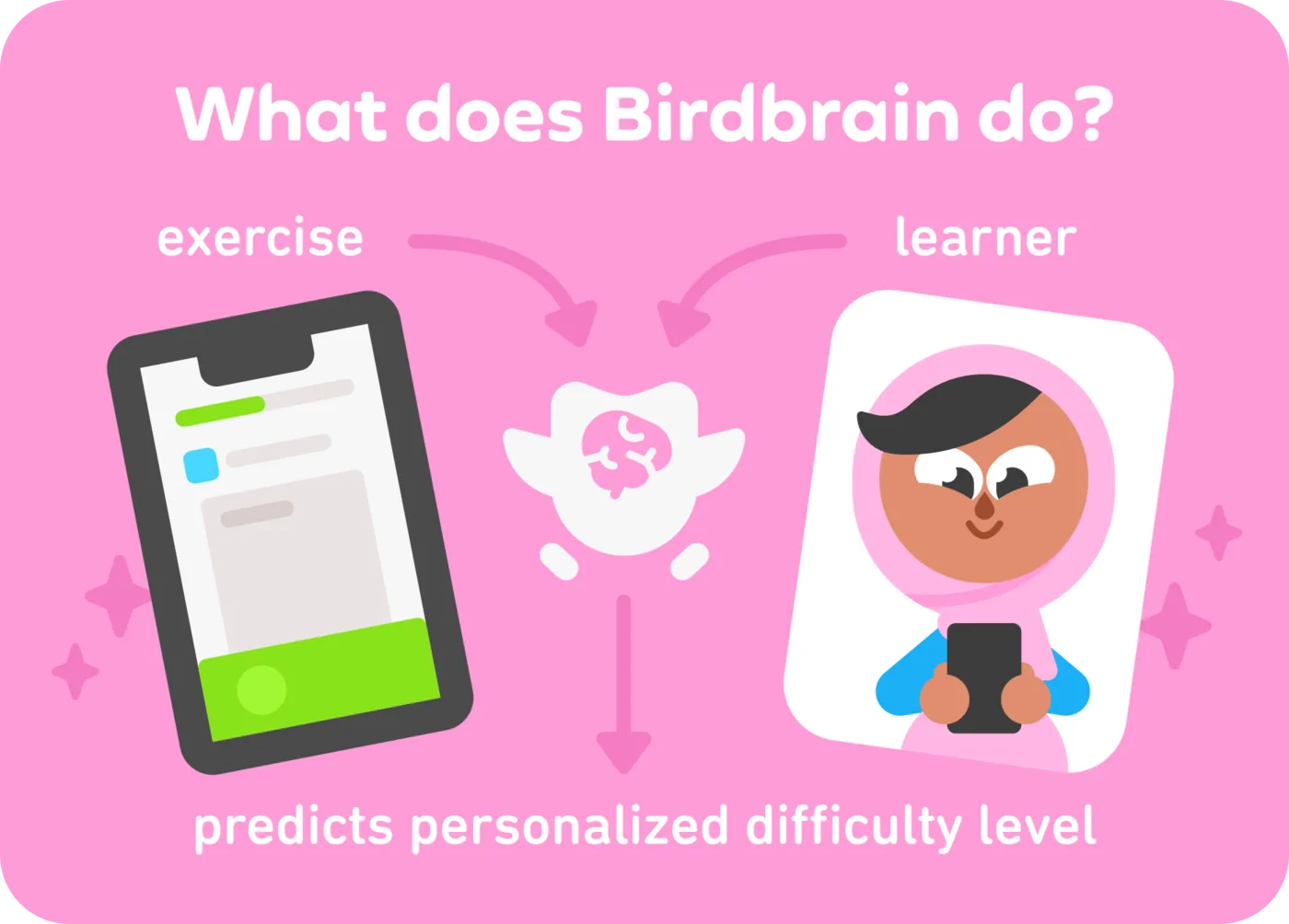
Duolingo · Introducing Birdbrain · Uso editorial
Duolingo described Birdbrain in 2020, a model that estimates what each person knows and the difficulty of each exercise, and picks what is at the right level for them. The post names both sides. Material that is too hard frustrates, too easy bores. In A/B tests, according to the company, those who received exercises chosen this way learned more and came back more the next day, and by October 2020 more than 20% of lessons were already going through the model. The magnitude was not published, only the direction. It is the central condition of flow turning into product, challenge adjusted to skill with immediate feedback. The same mechanism has a dark side, and it appeared in 2024 in internal TikTok documents that came to light in a lawsuit. The company defined the habit moment as 260 videos in the first week, which fits in under 35 minutes, and the time-limit tool reduced daily use from 108.5 to about 107 minutes. The source speaks of compulsive use, not of flow. The difference between the two products is the exit door.
Experimente
A piece to check in your own body what the text has just claimed.
The point where the task holds the person
Move the two controls and follow the point on the diagram. Notice that neither one alone defines where it lands: what matters is the relationship between the challenge of the task and the skill of whoever performs it.
- Where the point landed
- Flow
Challenge and skill move together. This is where the person loses track of time.
Flow is not a property of the task, it belongs to the relationship between the task and whoever performs it. A single difficulty level never serves everyone, and that is what justifies different paths for those arriving and those who have already mastered it.
Neighbouring concepts
Structures linked by a bridge of my own
Sibling concepts
Fontes
Enunciado taken from the current definition of the concept, formulated by Csikszentmihalyi in 1990.
- CSIKSZENTMIHALYI, M. Flow: the psychology of optimal experience. New York: Harper & Row, 1990. Source
Leitura complementar: Flow Laws of UX em inglês