viés
Anchoring bias
The first piece of information offered on a topic, especially when it involves numbers, works as a fixed reference point, which pulls the estimates made afterwards.
The first number becomes the ruler. Choose carefully which one you show first.
The first number that appears contaminates all the others, even when it is irrelevant. Amos TverskyRan, with Kahneman, the experiments that founded behavioural economics: anchoring, availability, the law of small numbers.3 references in this work:1973Availability: a heuristic for judging frequency and probability1971Belief in the law of small numbers1974Judgment under uncertainty: heuristics and biasesSee on Wikipedia ↗See in the bibliography → and Daniel KahnemanHalf the work this catalogue cites passes through him: anchoring, availability, the endowment effect, peak–end, the two systems.5 references in this work:2011Thinking, fast and slow1966Pupil diameter and load on memory1993When more pain is preferred to less: adding a better end1990Experimental tests of the endowment effect and the Coase theorem1991Anomalies: the endowment effect, loss aversion, and status quo biasSee on Wikipedia ↗See in the bibliography → demonstrated this in 1974 and the effect is resilient: it works even when people know the anchor was drawn at random. It is the mechanism of the crossed-out price next to the current price. And of cinema popcorn, where the small bucket goes for fifteen reais, the medium for twenty-two and the large for twenty-five. The seven reais of the first jump make the three of the second look like almost nothing, and a lot of people walk out with the large without having decided that. The effect gets worse with haste, with a crowded screen and with a hard decision, which is exactly the situation in which most purchases happen.
What the brain does with it
The biological mechanism behind the effect, and how much of it was actually measured.
The initial value becomes the starting point for the judgements that follow, even when it is admittedly random. The explanation with most support is selective accessibility: the anchor makes the person look for reasons why the value could be right, and those reasons stay available when they go on to estimate. It is a cognitive mechanism, tested by manipulating what the person is led to consider. The judgement the anchor shifts is a valuation, and valuation shows up consistently in the ventromedial prefrontal cortexIt makes the global judgement, the final opinion on an entire experience, not on each moment of it. It is because of it that the person sums up a ten-screen flow in a single sentence.See it in Emotion →See in the glossary →, in a survey of 206 imaging studies (BartraOne reference in this work:2013The valuation system: a coordinate-based meta-analysis of BOLD fMRI experiments examining…See in the bibliography →, McGuire and Kable, 2013). Nobody measured there the shift an anchor causes, and the link is mine.
The body this law presumes
Who it was measured on, and what changes when the body on the other side is another.
The first number becomes the ruler, and the most repeated explanation for who escapes this is being at ease with numbers. KakinohanaMeasured decision biases in 409 Brazilians and found that numeracy does not protect against anchoring, contrary to what was assumed.One reference in this work:2023Differences in decisions affected by cognitive biases: examining human values, need for co…See in the bibliography → and Pilati went and measured it in 409 Brazilians aged 18 to 80, and numeracy moderated the framing effect and the certainty effect, but in anchoring it moderated nothing. Those who were better with numbers anchored along with the rest. From here on it is my own reasoning, with no study I have found. A price in foreign currency should anchor less than the same price in reais, because the ruler does not yet exist in the reader’s head, and whoever is on a tight budget anchors on what fits in the month, not on the full price.
How design translates it
What to do with it on a screen, without turning a finding into a rule.
How to measure this in your product
A R$ 299 plan crossed out next to a R$ 99 “premium” one shifts the perception of value. On menus, a bigger gap between the small and the medium than between the medium and the large creates a sense of advantage in the largest. Anchoring is legitimate when it eases a real comparison between products with clear differences. Which price appears first on the screen is a decision made in the design, before the layout.
Onde vira manipulação
The same lever, pointed at the person on the other side.
There is abuse when the contrast is fabricated: inflated prices that were never charged, misleading discounts, irrelevant comparisons. The ethical practice is to compare with prices the shop actually charged.
Where it breaks
Where the law does not hold, holds less, or holds in reverse.
The anchor needs to be plausible to work, and an absurd crossed-out price tends to trigger suspicion instead of comparison. And there is a limit of method that hits whoever does research: the first question in a script anchors all the following ones, so the order of your questionnaire is producing part of the answer you will attribute to the user.
Um caso
A real product where this showed up, with what happened and where to check it.
The US$ 999 that never existed, and the crossed-out price the court crossed out
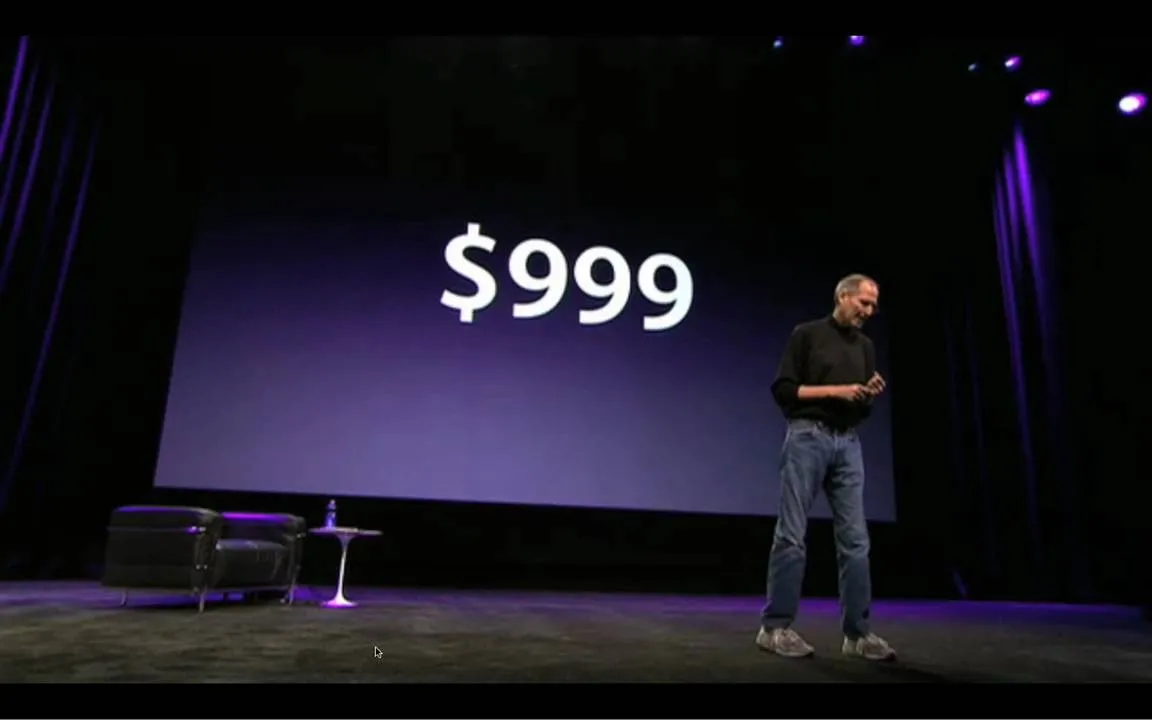
Apple · presentation of 27 January 2010, via Fortune · Uso editorial
At the iPad launch, in 2010, Steve Jobs presented the price starting from the number the press had been speculating about, 999 dollars, and only then announced that it started at 499. The official press release called the device revolutionary and the price unbelievable. The first number the audience saw was not the price, and the real price was assessed against it. The case documents the presentation, not the effect on sales. What has a measurement is the fabricated anchor. In 2014 Overstock.com told investors that a California court had imposed a 6,819,000-dollar fine on it for misleading comparative pricing. The crossed-out price next to the real price was calculated by a formula over the wholesale cost, and sometimes came from a similar product, not an identical one. The company itself said that the average advertised discount was 33% and that the method the court required would take it to 26%. Those seven points are the size of the ruler the anchor was moving. A crossed-out price is an anchor, and the question that matters for your product is where the crossed-out number came from.
Experimente
A piece to check in your own body what the text has just claimed.
The first number changes what looks expensive
Look at the R$ 99 price on its own and form an opinion. Then click to show the R$ 299 plan next to it and look at the R$ 99 again. The value has not changed.
The R$ 99 value did not change between the two states, but the feeling did. The comparison is legitimate when R$ 299 is a price the shop actually charges. It becomes manipulation when the anchor was never charged.
Neighbouring concepts
Structures linked by a bridge of my own
Sibling concepts
Fontes
Enunciado citado de Tversky; Kahneman, 1974.
- TVERSKY, A.; KAHNEMAN, D. Judgment under uncertainty: heuristics and biases. Science, v. 185, n. 4157, p. 1124-1131, 1974. DOI
Leitura complementar: The Anchoring Principle NN/g em inglês