lei
Miller’s law
The magical number seven, plus or minus two: some limits on our capacity for processing information.
Group into blocks of up to four, and make the blocks contrast with each other.
This is probably the most cited and most misused number in interface design. George George Armitage MillerWrote, in 1956, the magical number seven paper, which the field itself later corrected to about four.One reference in this work:1956The magical number seven, plus or minus twoSee on Wikipedia ↗See in the bibliography → published an article in 1956 on the “magical number seven, plus or minus two”, and it became a licence to put seven of everything on every screen. Two things got lost along the way. The first is that Miller was talking about items the person holds in their head, not items visible in a list, which they can reread whenever they like. The second is that later research knocked the seven down to about four. What survives is the mechanism, and it is the most useful part of the law: grouping does not reduce the information, it reduces the number of packets memory needs to carry at once.
What the brain does with it
The biological mechanism behind the effect, and how much of it was actually measured.
Without a grouping strategy, working memoryThe mental space where the person holds what they are using right now. It holds about four things, and they fade in seconds if they are not used.See it in Memory →See in the glossary → retains about four items, not seven. Miller’s “seven plus or minus two” described what the person can repeat back, and the review that holds up today found a lower limit for what they can keep active while operating on it. Keeping information available like this depends on the prefrontal cortexThe region behind the forehead, where the person decides, plans and sustains attention. It keeps one thing in focus at a time and inhibits the rest: it is where the bottleneck of conscious decision usually tightens.See it in Memory →See in the glossary → and the frontoparietal circuitsThe pair that supports working memory: the prefrontal cortex holds the information active while the parietal lobe keeps track of where things are.See it in Memory →See in the glossary →. What was measured were working memory tasks, the function the law invokes, and not the law itself. What practice increases is the size of each packet, not the number of packets.
The body this law presumes
Who it was measured on, and what changes when the body on the other side is another.
How many items working memory holds at once changes with age, and the broadest measurement there is of the visual part of it comes from BrockmoleTested visual working memory in 55,753 people aged 8 to 75, the broadest measurement there is of how capacity changes with age.One reference in this work:2013Age-related change in visual working memory: a study of 55,753 participants aged 8-75See in the bibliography → and Logie, who tested 55,753 people between 8 and 75 years old. Capacity rises until around 20 and falls in a straight line from there: in their early fifties, the average adult holds less than an eight-year-old. The limit is a range, and it depends on the age of whoever is on the other side.
How design translates it
What to do with it on a screen, without turning a finding into a rule.
How to measure this in your product
Segmenting into blocks, the chunks, and using clear visual grouping keeps the load within the limit. The telephone number is the oldest example: nobody remembers eleven digits in a row, but they remember the area code, then five digits and then four, because the brain carries three packets instead of eleven. On a page with a lot of information, what allows everything to be shown without overloading is the contrast between the sections, because that is what lets each block be treated as a single unit.
Where it breaks
Where the law does not hold, holds less, or holds in reverse.
“Seven plus or minus two” became a licence to put seven of everything. The number was never a goal. It was a ceiling, and the real ceiling is four.
Um caso
A real product where this showed up, with what happened and where to check it.
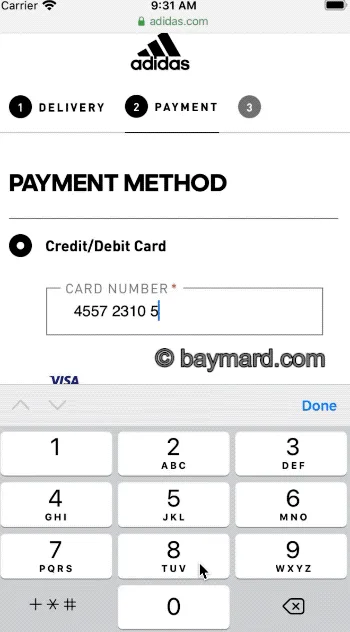
The card number in blocks of four
Baymard Institute · Credit Card Number Field: Auto-Format Spaces · Uso editorial
In the Baymard Institute’s tests, whoever types in the card number tends to copy it in the format in which it is printed on the plastic, in groups of four, and checks it block by block before submitting. When the field inserts the spaces on its own, the check works, because the screen and the card show the same blocks. When it does not, the person types the spaces themselves and some sites return an error because of it. Sixteen digits in a row do not fit in anyone’s working memory. Four blocks of four do. In 2025, 15% of e-commerce sites still did not format the spaces, against 50% in 2019. What the law describes is exactly this, grouping what needs to stay in the head for a moment. It does not describe the size of a menu, although it is cited that way all the time. A menu is recognition, not recall, as Jakob NielsenWrote the ten usability heuristics and created the heuristic evaluation method that this site treats as triage, not as a test.4 references in this work:199410 usability heuristics for user interface design2000End of Web Design2009Short-term memory and web usability1990Heuristic evaluation of user interfacesSee in the bibliography → wrote in 2009, and it does not need to fit into seven.
Experimente
A piece to check in your own body what the text has just claimed.
Why phone and card numbers come in blocks
Look at the sequence below and try to memorise it. Then click Group and try again. They are the same twelve digits both times — nothing has been removed.
481590372641
- Units to hold
- 12
- Working memory limit
- ~4
Nothing has been removed: the twelve digits are still there. Grouping does not reduce the information, it reduces the number of units that working memory has to hold at the same time, from twelve to three, within what it can carry.
Who actually said this
The name the law carries, who actually wrote it, and why the mix-up stuck.
Miller’s seven really was seven, only it measured something else. Today the measured limit is four, and Miller never spoke of interfaces.
The 1956 paper is a good-humoured lecture about a coincidence: seven kept appearing in experiments on different things, and Miller jokes that the number is persecuting him. He himself writes that the cases are not the same phenomenon, and he never said menus should have seven items. When the field measured again, with tasks that block the grouping tricks, the number fell to about four (CowanRedid Miller’s count with a better method and arrived at about four items, not seven. It is the number this site uses.One reference in this work:2001The magical number 4 in short-term memorySee in the bibliography →, 2001). A constant of physics does not halve when someone measures it again. That is why this site uses Miller as proof that calling these findings laws is an exaggeration.
COWAN, N. The magical number 4 in short-term memory. Behavioral and Brain Sciences, v. 24, n. 1, p. 87-114, 2001. DOI
Neighbouring concepts
Structures linked by a bridge of my own
Sibling concepts
Fontes
Enunciado citado de Miller, 1956.
- MILLER, G. A. The magical number seven, plus or minus two. Psychological Review, v. 63, n. 2, p. 81-97, 1956. DOI
- NIELSEN, J. Short-term memory and web usability. Nielsen Norman Group, 2009. Source
Leitura complementar: Miller’s Law Laws of UX em inglês