viés
Illusion of control
People tend to overestimate their degree of control over events that are, for the most part, random.
Give real control along with the feeling of control.
Ellen LangerMeasured the illusion of control: people who pick their own lottery ticket ask more to sell it back.One reference in this work:1975The illusion of controlSee in the bibliography → showed in 1975 that people who chose their own lottery ticket asked a higher price to sell it back than those who were handed a ticket at random. The outcome of the draw is the same in both cases; the feeling of being in charge is not. In interfaces, this mechanism is everywhere: the button that responds to touch, the control the person adjusts, the extra question during a calculation that was already finished. Used well, it gives the person back the feeling of steering the process. Used badly, it is a promise of influence over something they do not influence at all.
What the brain does with it
The biological mechanism behind the effect, and how much of it was actually measured.
The effect is behavioural and was measured directly by Langer: people who choose their own lottery ticket ask a higher price to sell it back, and the difference appears only when there was a choice. The sense of agency has its own literature in neuroscience, and that is not where the structure I cite here comes from. The most consistent is the ventral striatumPart of the reward circuit that tallies gain and loss. It reacts more strongly to losing than to gaining the same amount — the asymmetry behind a good part of the decision biases in this catalogue.See in the glossary →, which tracks the value of an outcome in a survey of 206 imaging studies (BartraOne reference in this work:2013The valuation system: a coordinate-based meta-analysis of BOLD fMRI experiments examining…See in the bibliography →, McGuire and Kable, 2013). It was measured in value, not in imagined control, and the link is mine.
The body this law presumes
Who it was measured on, and what changes when the body on the other side is another.
The founding study, Langer’s, was done with fifty-three office workers from Long Island, almost all men, and the tickets were American football trading cards, a material that already presupposes repertoire. The bias says the feeling of control already improves the experience, even when the control is small. That presupposes someone who already has some real control. For those who have little, at work, in money or in access, a feeling of control with no control at all does not comfort, it frustrates. And what counts as control changes from place to place. The distinction between primary control, acting on the situation to change it, and secondary control, adjusting oneself to it, predates WangMeasured that the West seeks primary control — acting on the situation — and East Asia, secondary: adjusting to it.One reference in this work:2012Culture, control, and illusory pattern perceptionSee in the bibliography →, Whitson and Menon. They measured something else, what each side seeks when it loses control. Under threat, Westerners chose horoscopes that explain themselves, and East Asians, horoscopes that explain others. What comes out of that is a design clue, not a rule. A “customise” button speaks to those seeking primary control, and for those seeking secondary control what may reassure is knowing what is going to happen.
How design translates it
What to do with it on a screen, without turning a finding into a rule.
How to measure this in your product
Used well, it gives a sense of personalisation: the animation that responds to touch, the control the person adjusts, the symbolic choice that makes the result feel like their own. Some online tests show extra questions during the “calculating” phase just to reinforce the impression that the result is tailor-made.
Onde vira manipulação
The same lever, pointed at the person on the other side.
Applied to automated systems and recommendation algorithms, it induces excessive trust in decisions that are not very transparent. The designer’s role is to balance real and perceived control, communicating clearly the limit of each action.
Where it breaks
Where the law does not hold, holds less, or holds in reverse.
The illusion is only useful when perceived control goes along with some real control, and it breaks when it does not. A button that does nothing works until the person finds out, and finding out costs their trust in every other button. The reverse test also holds: if you need to fake control to make the wait tolerable, the problem is the wait.
Um caso
A real product where this showed up, with what happened and where to check it.
The “not interested” button that has almost no effect
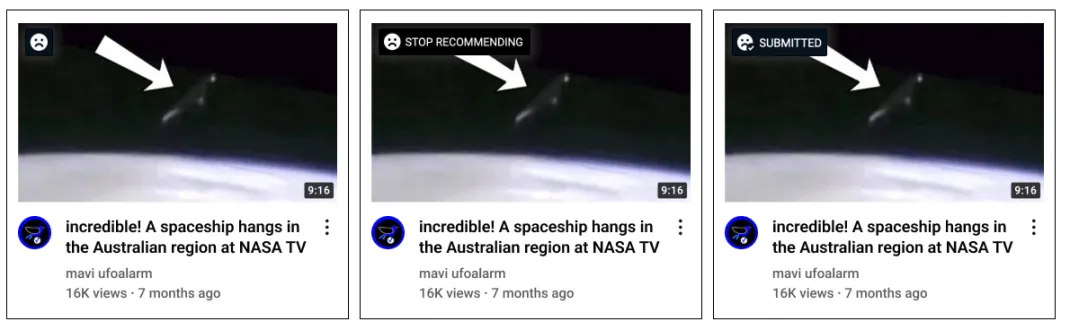
Mozilla Foundation · Does This Button Work? · Uso editorial
In 2022 Mozilla measured whether YouTube’s controls do what they promise. More than 22,000 people donated data through a browser extension, in a controlled experiment in which a stop-recommending button sent YouTube one of the official signals, or nothing. The “don’t recommend channel” button prevented about 43% of unwanted recommendations. “Remove from history” prevented 29%, “dislike” 12% and “not interested” 11%. Not even the most effective control prevents half, and people notice. In the qualitative part, they say using the controls changes nothing, and some watch logged out or through a VPN to get any effect. It is the reverse of the classic bias, in which the person overestimates the control they have. Here they underestimate it, and rightly so. Mozilla is an interested party, and the percentages hold as a comparison between groups. The case shows the cost of a button that promises more than it delivers. Once the gap is discovered, it contaminates trust in every other control.
Experimente
A piece to check in your own body what the text has just claimed.
The door-close button
The lift door is open and will close on its own. Press “Close door” as many times as you like in the meantime, as you would in a hurry.
Fechando. Aperte à vontade.
Interacting produces a sense of agency even when the action changes nothing, and the cost of that is not always the same. An inert button that merely soothes the wait is one thing; one that makes the person believe they influenced an outcome that was already decided — a price, a queue, a credit check — is another. The two are set apart by who gains from the sense of control: the one who feels it or the one who offered it.
Neighbouring concepts
Structures linked by a bridge of my own
- ventral striatum
Sibling concepts
Fontes
Enunciado citado de Langer, 1975.
- LANGER, E. J. The illusion of control. Journal of Personality and Social Psychology, v. 32, n. 2, p. 311-328, 1975. DOI
Leitura complementar: Illusion of Control IxDF em inglês